Frequently asked
Is tonight good for stargazing in Rapid City?
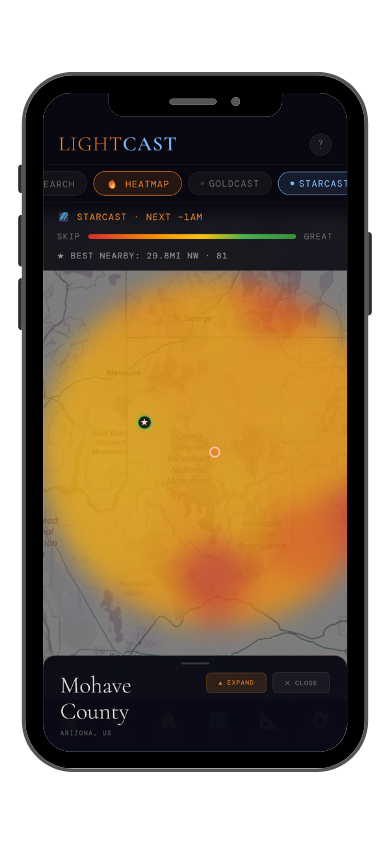
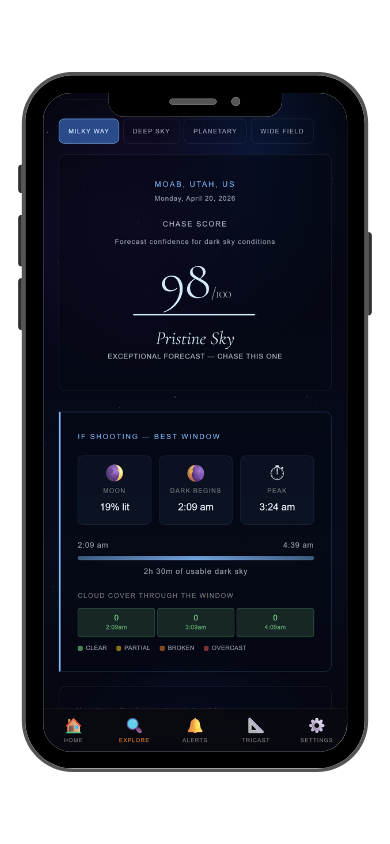
The live score above pulls today's forecast and runs it through StarCast's scoring model, factoring in cloud cover, moon illumination, Bortle class, humidity, and atmospheric transparency. Above 70 is an excellent night for astrophotography. Below 40, conditions are poor. The score updates daily.
What makes Rapid City good for astrophotography?
Rapid City sits at the eastern edge of the Black Hills in South Dakota, and the hills themselves — just minutes to the west — provide Bortle Class 3 to 4 skies that city limits cannot match. Custer State Park and Wind Cave National Park, both within an hour's drive, are genuine dark sky destinations with dramatically better transparency. The Black Hills rise to over 7,200 feet at Harney Peak, and shooting from elevation gives astrophotographers a lower, cleaner horizon than the plains. The granite spires of the Needles and Cathedral Spires in Custer State Park are classic foreground subjects. Rapid City itself sits at Bortle Class 5 to 6, making it a practical base for dark sky excursions rather than a shooting location in its own right.
When is the Milky Way visible near Rapid City?
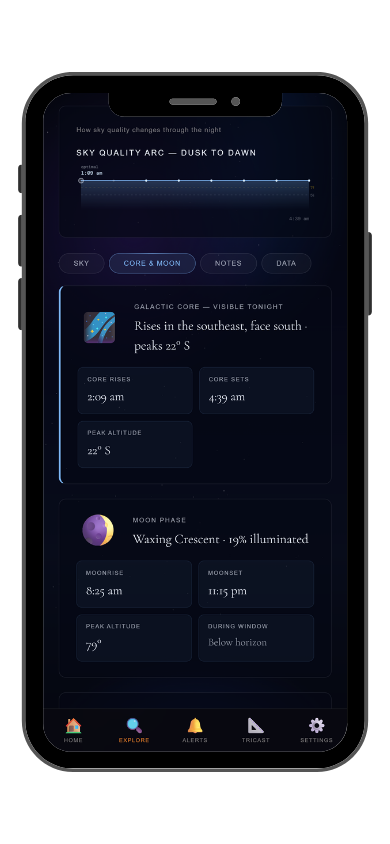
The galactic core is visible from approximately late March through early October, with the peak season running May through August when the core rises high enough for wide-angle compositions. The sweet spot for astrophotography near Rapid City is June through August: long summer nights don't fully apply here at this latitude, but astronomical darkness still arrives before midnight and conditions are generally stable. New moon windows in July and August are the most sought after, combining high galactic core altitude with the best transparency of the year.