Frequently asked
Is tonight good for stargazing in Red Lodge?
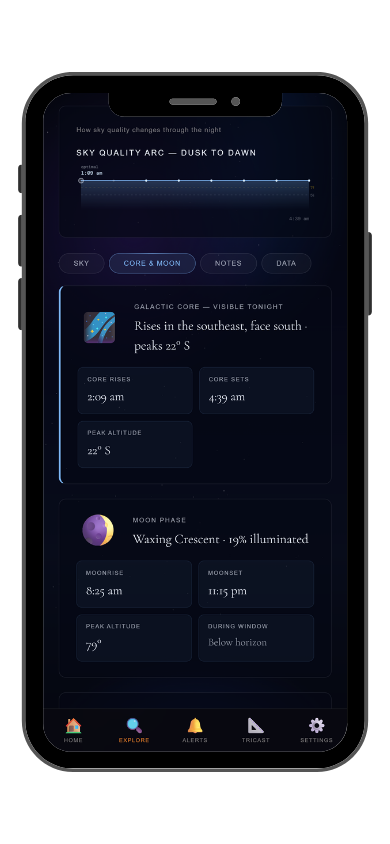
The live score above pulls today's forecast and runs it through StarCast's scoring model, factoring in cloud cover, moon illumination, Bortle class, humidity, and atmospheric transparency. Above 70 is an excellent night for astrophotography. Below 40, conditions are poor. The score updates daily.
What makes Red Lodge good for astrophotography?
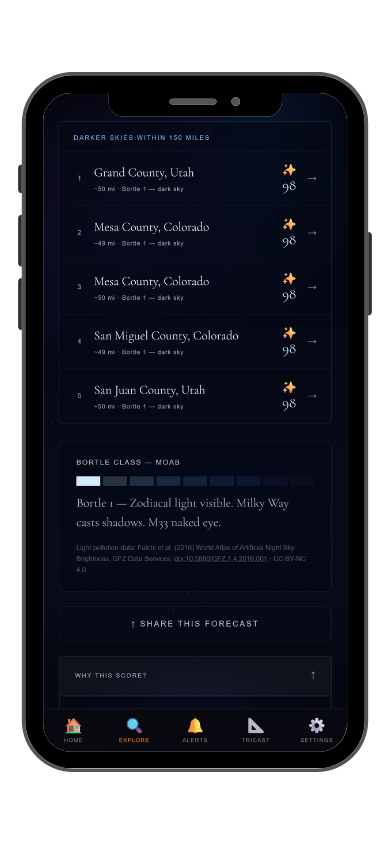
Red Lodge sits at 5,600 feet at the northeastern foot of the Beartooth Range — widely regarded as the most dramatic road-accessible mountain terrain in the lower 48. The Beartooth Highway begins in Red Lodge and climbs to Beartooth Pass at 10,947 feet, and the Beartooth Plateau above the pass is one of the most exceptional high-altitude astrophotography platforms in North America, with Bortle Class 2 skies and a 360-degree alpine horizon above the treeline. The Custer Gallatin National Forest and Absaroka-Beartooth Wilderness extend for hundreds of thousands of roadless acres in all directions. Red Lodge is small enough that its own light dome is minor, and the canyon terrain rising immediately south of town screens what little glow exists. Granite Peak — Montana's highest at 12,807 feet — is visible from the plateau and serves as a massive foreground anchor.
When is the Milky Way visible near Red Lodge?
The galactic core is visible from late March through early October. The Beartooth Highway typically opens in late May or early June, and Beartooth Pass and the high plateau are accessible through mid-October weather permitting. Prime astrophotography season on the plateau runs late June through September, when the highway is reliable, the core is well-positioned, and nights are long enough for productive sessions. The plateau's extreme elevation means sub-freezing temperatures are possible any month — preparation is essential. New moon windows in July and August offer the highest core altitude above the plateau with the most accessible conditions. Aurora photography is occasionally possible from this latitude on active geomagnetic nights.