Frequently asked
Is tonight good for stargazing at Redwood National Park?
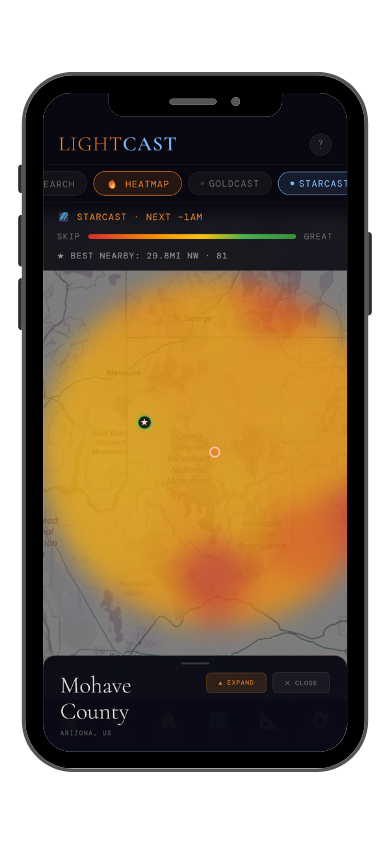
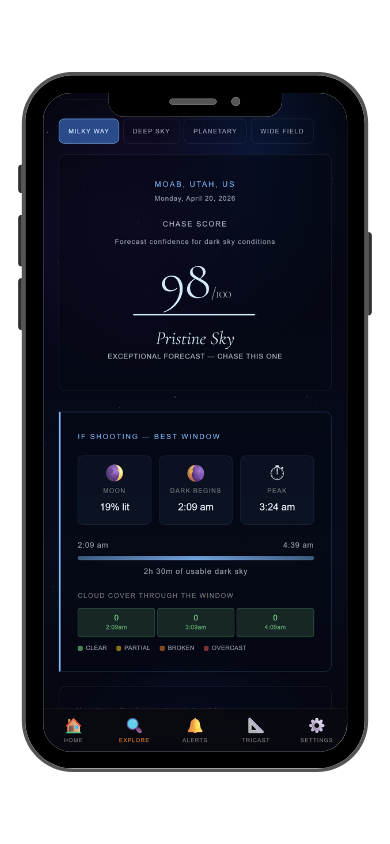
The live score above pulls today's forecast and runs it through StarCast's scoring model, factoring in cloud cover, moon illumination, Bortle class, humidity, and atmospheric transparency. Above 70 is an excellent night. Below 40, conditions are poor. The score updates daily.
What makes Redwood National Park good for astrophotography?
Redwood National and State Parks stretch along the remote northern California coast, well north of the San Francisco Bay Area light dome. The park offers two distinct night sky environments: the coastal bluffs and beaches where the Pacific horizon is open and dark, and the interior old-growth forest where shooting upward through the canopy of the world's tallest trees creates a singular astrophotography experience found nowhere else on Earth. The sea stacks, driftwood-strewn beaches, and towering redwoods provide foreground that ranges from dramatic to ethereal. Bortle Class 3 to 4 skies are accessible in the park's inland areas.
When is the Milky Way visible at Redwood National Park?
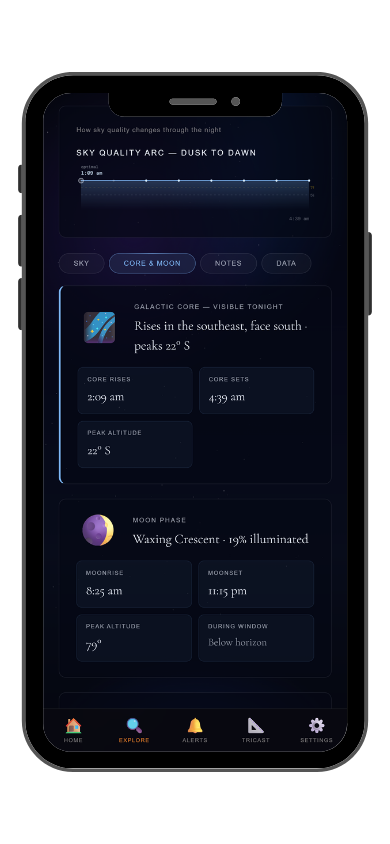
The galactic core is visible from approximately April through October. The northern California coast is heavily influenced by marine layer fog, which rolls in frequently from the Pacific, particularly in summer. June and July offer peak Milky Way visibility but also peak fog frequency. Late summer and fall, when the marine layer recedes, offer the most reliable clear nights. Checking coastal fog forecasts in addition to standard cloud cover is essential for planning a night shoot in this region.