Frequently asked
Is tonight good for stargazing at Rondane?
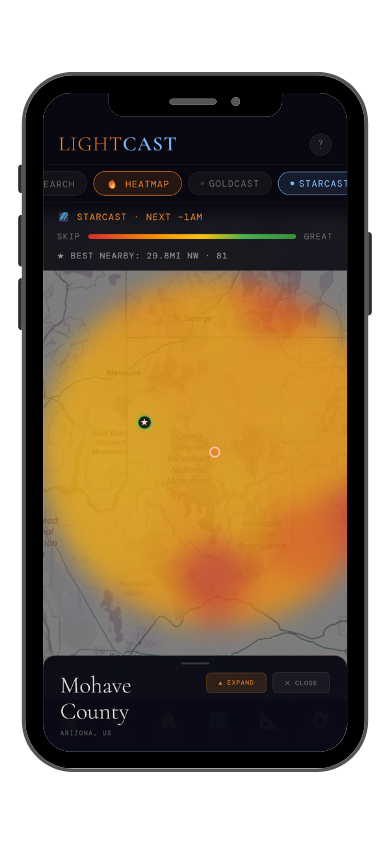
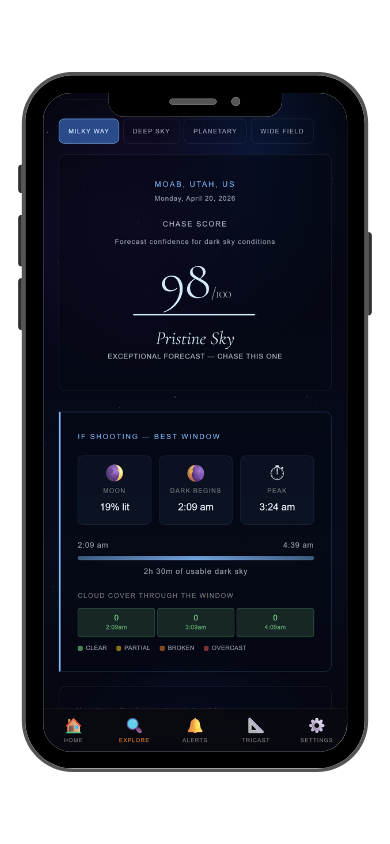
The live score above pulls today's forecast and runs it through StarCast's scoring model, factoring in cloud cover, moon illumination, Bortle class, humidity, and atmospheric transparency. Above 70 is an excellent night. Below 40, conditions are poor. The score updates daily.
What makes Rondane good for astrophotography?
Rondane is Norway's oldest national park, established in 1962, covering a high, continental mountain massif in Innlandet county. Ten peaks exceed 2,000 meters, and the park sits in one of Norway's driest climate zones: unlike the western fjords, Rondane receives relatively little precipitation due to its inland position in the rain shadow of the Jotunheimen range. Light pollution is minimal across the entire park: Lillehammer is 100 kilometers to the south and Oslo 250 kilometers, with only scattered small towns between. The glacially shaped landscape of rounded summits, wide valleys, and reindeer-grazed plateaus creates an austere, open foreground with few obstructions.
When is the Milky Way visible at Rondane?
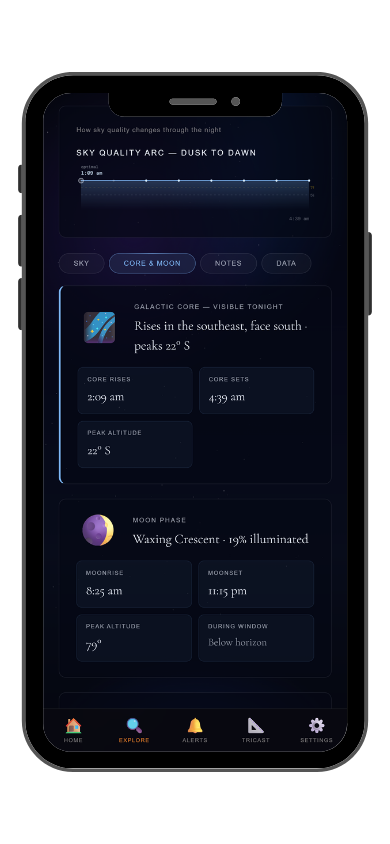
The galactic core is visible from March through October. Rondane's continental climate means clearer skies than Norway's coast, particularly in late summer and early autumn when high-pressure systems settle over Scandinavia. August through October is often the most productive window: nights are long enough for useful darkness, the core is visible in the south, and aurora activity begins increasing as winter approaches. Access is via the Mysuseter road from Otta or Rondvassbu mountain lodge. The park's high elevation positions photographers above valley inversions on cold clear nights.