Frequently asked
Is tonight good for stargazing in Roswell?
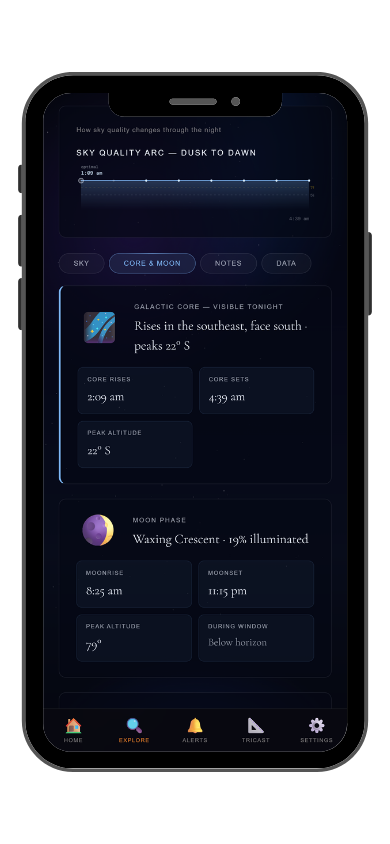
The live score above pulls today's forecast and runs it through StarCast's scoring model, factoring in cloud cover, moon illumination, Bortle class, humidity, and atmospheric transparency. Above 70 is an excellent night for astrophotography. Below 40, conditions are poor. The score updates daily.
What makes Roswell good for astrophotography?
Roswell sits at 3,600 feet on the eastern edge of the Chihuahuan Desert in southeastern New Mexico, surrounded by flat Pecos Valley rangelands that extend for miles with almost no light interference to the south, east, and north. Bortle Class 3 to 4 skies are available just outside the city limits, and the wide, flat terrain means the entire horizon — including the crucial southern sky where the Milky Way core rises — is unobstructed. The Sacramento Mountains rise about 40 miles to the west, providing easy access to even darker Bortle Class 2 conditions in the Lincoln National Forest. Roswell's low annual precipitation and continental high-desert air mass produce excellent atmospheric transparency. The region is also one of the flattest and most photogenic in the state for wide, low-foreground Milky Way arch compositions under open skies.
When is the Milky Way visible in Roswell?
The galactic core is visible from mid-February through early November at Roswell's southern New Mexico latitude. The core clears the eastern horizon early in spring and climbs to an impressive altitude in the southern sky by midsummer. Prime Milky Way season runs April through September. The flat terrain east and south of Roswell is particularly suited for panoramic arch shots, where the entire galactic core can be captured in a single composition or stitch. Monsoon moisture arrives in July and August but dissipates quickly over the plains, and clear desert nights following storms can deliver remarkable transparency.