Frequently asked
Is tonight good for stargazing in Ruidoso?
The live score above pulls today's forecast and runs it through StarCast's scoring model, factoring in cloud cover, moon illumination, Bortle class, humidity, and atmospheric transparency. Above 70 is an excellent night for astrophotography. Below 40, conditions are poor. The score updates daily.
What makes Ruidoso good for astrophotography?
Ruidoso sits at 6,900 feet in the Sacramento Mountains of southern New Mexico, surrounded by the Lincoln National Forest. Sierra Blanca Peak — at 11,981 feet the southernmost thirteener in the United States — rises just northwest of town and is visible as a dramatic foreground from many shooting locations in the forest. The Mescalero Apache Reservation borders Ruidoso and maintains low light output across a large area, keeping the sky dark in multiple directions. Bortle Class 2 to 3 conditions are available within a very short drive, and the elevation provides the thin, transparent atmosphere that serious astrophotographers seek. The surrounding forest also blocks lower-altitude heat shimmer that plagues desert-floor sites, improving seeing quality for longer focal-length work.
When is the Milky Way visible in Ruidoso?
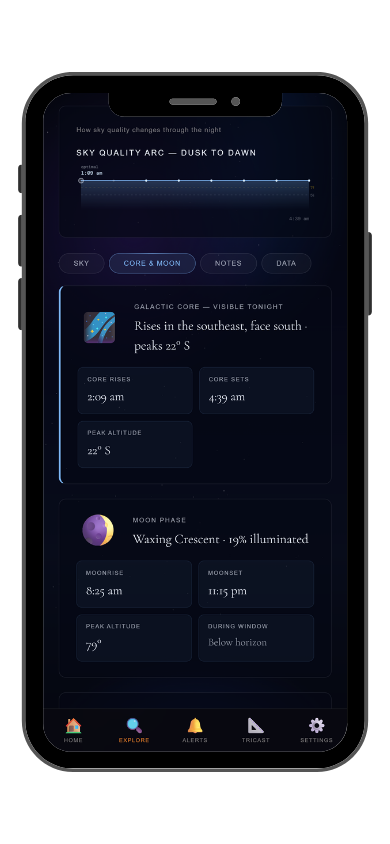
The galactic core is visible from late February through early November at Ruidoso's latitude and elevation. The core rises in the southeast and reaches comfortable shooting altitude by April or May. Prime astrophotography season runs May through September, with the core at its highest in June and July. Monsoon season brings afternoon and evening storms in July and August, but the Sacramento Mountains can see swift clearing, particularly when storm systems move east. Post-storm nights at this elevation are often among the clearest of the year. New moon windows in May, June, and early July before monsoon onset offer the most reliable conditions.