Frequently asked
Is tonight good for stargazing in Salida?
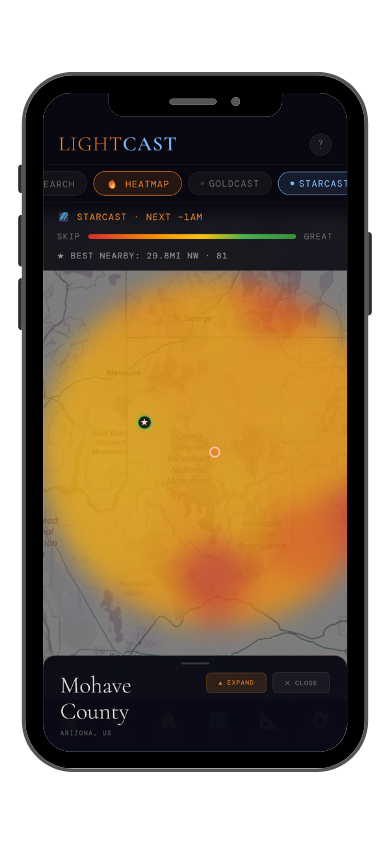
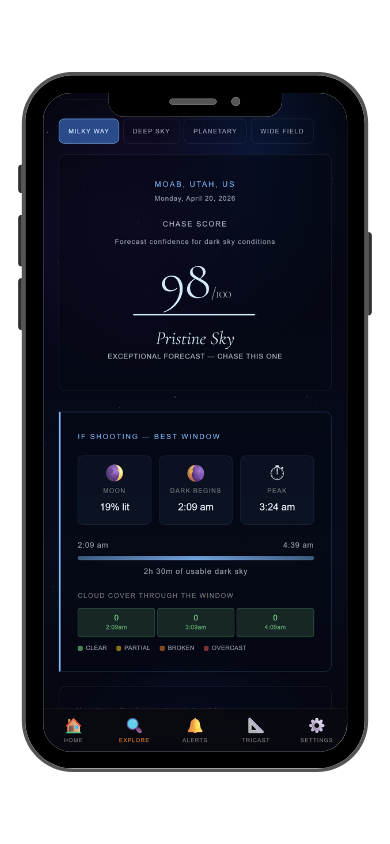
The live score above pulls today's forecast and runs it through StarCast's scoring model, factoring in cloud cover, moon illumination, Bortle class, humidity, and atmospheric transparency. Above 70 is an excellent night for astrophotography. Below 40, conditions are poor. The score updates daily.
What makes Salida good for astrophotography?
Salida sits at 7,100 feet in the upper Arkansas River valley, surrounded by mountains on all sides including the Sawatch Range to the west and the Sangre de Cristo Range to the east. The valley's basin geography and modest town size mean the sky overhead achieves Bortle Class 3 to 4 conditions quickly as you move out of the small downtown area. The Arkansas River cuts through Browns Canyon National Monument just north of town, offering dramatic canyon walls and river reflections as foreground. Poncha Pass to the south and the open San Luis Valley beyond are among the darkest areas in Colorado. Salida's arts community has historically embraced night sky preservation, and the area does not suffer from significant suburban sprawl to dilute sky quality.
When is the Milky Way visible in Salida?
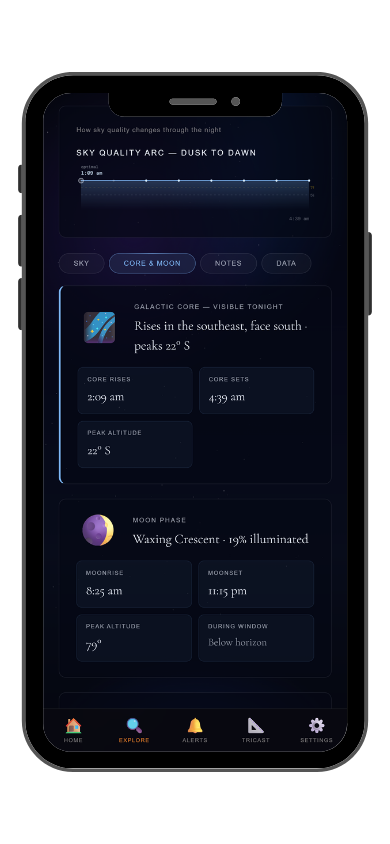
The galactic core is visible from late March through early October. The prime astrophotography window runs May through September. The San Luis Valley — reachable via Poncha Pass in about 30 minutes — offers some of the best dark sky conditions in Colorado at Bortle Class 2, and its flat terrain makes it ideal for wide panoramic Milky Way compositions. Great Sand Dunes National Park, 90 minutes to the south, is one of the premier astrophotography destinations in the region and is a highly accessible day-trip from Salida for dark-sky excursions. New moon windows in June and early July represent the ideal balance of core altitude and clear-sky frequency.