Frequently asked
Is tonight good for stargazing near Santa Fe?
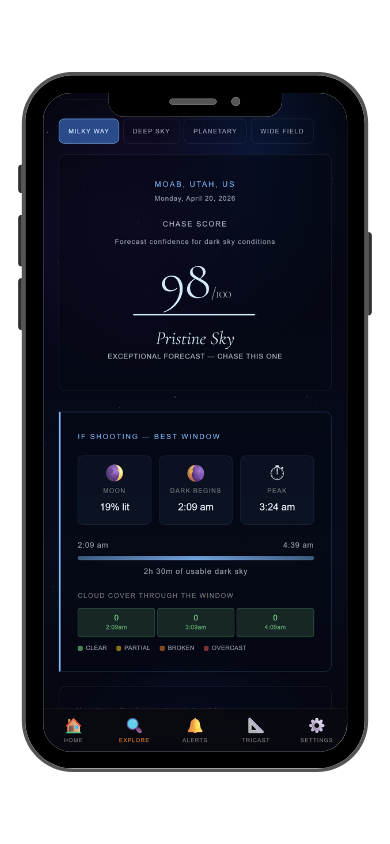
The live score above pulls today's forecast and runs it through StarCast's scoring model, factoring in cloud cover, moon illumination, Bortle class, humidity, and atmospheric transparency. Above 70 is an excellent night. Below 40, conditions are poor. The score updates daily.
What makes the Santa Fe area good for astrophotography?
Santa Fe sits at 7,200 feet in the Sangre de Cristo Mountains, making it one of the highest-elevation state capitals in the US. The city itself creates a light dome, but the surrounding Santa Fe National Forest and the Valles Caldera National Preserve reach Bortle Class 2 conditions within a short drive. New Mexico is home to nine DarkSky-certified locations and the state has some of the strongest light pollution protection policies in the country, with Catron County ranking as one of the least light-impacted counties in the US. Hyde Memorial State Park, about 12 miles from the Plaza, is a frequently used base for night shooting with adobe and southwestern architecture foreground options. The Jemez Mountains to the west offer multiple positions with open sky and volcanic caldera terrain.
When is the Milky Way visible near Santa Fe?
The galactic core is visible from March through October, with peak from May through August. New Mexico's high-altitude dry climate delivers some of the clearest and most consistent skies in the country. The summer monsoon from July through early September brings afternoon thunderstorms that typically clear by evening, and the storm light itself can make for dramatic photography before full dark. The Valles Caldera and surrounding national forest are 45 minutes west and provide the darkest accessible shooting positions from the Santa Fe area.