Frequently asked
Is tonight good for stargazing at Scotts Bluff National Monument?
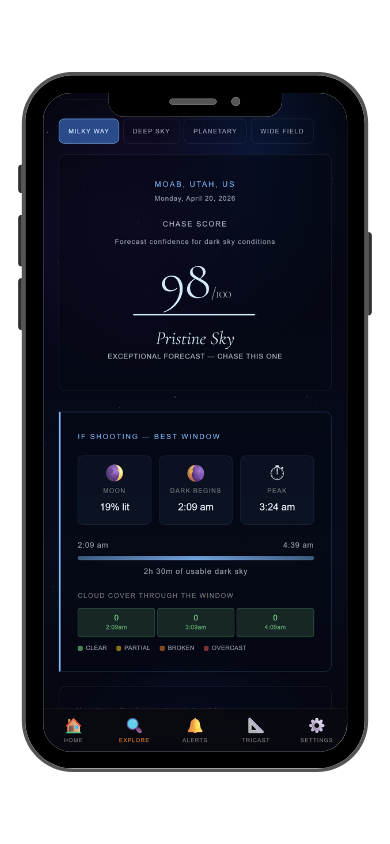
The live score above pulls today's forecast and runs it through StarCast's scoring model, factoring in cloud cover, moon illumination, Bortle class, humidity, and atmospheric transparency. Above 70 is an excellent night. Below 40, conditions are poor. The score updates daily.
What makes Scotts Bluff National Monument good for astrophotography?
Scotts Bluff National Monument in the Nebraska Panhandle preserves a dramatic promontory of eroded badlands bluffs rising 800 feet above the North Platte River valley — a landmark that guided hundreds of thousands of emigrants on the Oregon, California, and Mormon Trails through the 1800s. The surrounding Nebraska Panhandle is one of the most remote and dark corners of the Great Plains, with Bortle Class 2 to 3 skies over a landscape of open range, river valleys, and wide wheat plains. The bluff itself, visible from miles away, provides an iconic and historically loaded foreground against the Milky Way. The summit road offers elevated views over the broad North Platte valley with dark horizons extending in all directions.
When is the Milky Way visible at Scotts Bluff National Monument?
The galactic core is visible from April through October, peaking in July and August. The Nebraska Panhandle's semi-arid high plains climate delivers good clear night frequency, better than the wetter eastern parts of the state. Summer thunderstorms are possible but typically move through quickly on the open plains. Fall is particularly clear and dry, with excellent transparency extending well into October. The summit road's access hours should be checked before planning nighttime visits, as gate closures vary seasonally.