Frequently asked
Is tonight good for stargazing at Sheldon National Wildlife Refuge?
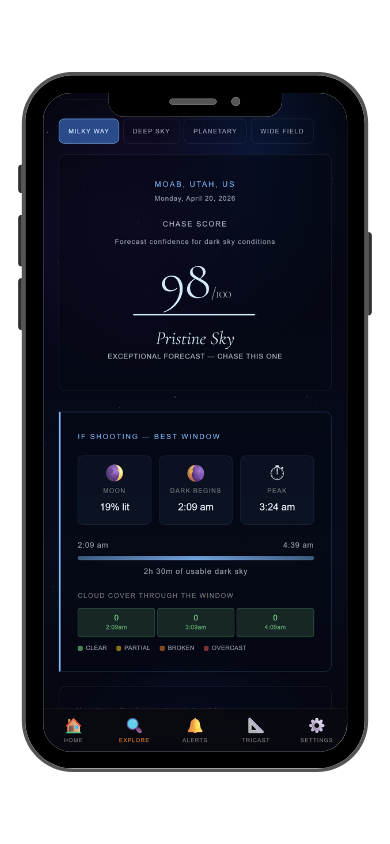
The live score above pulls today's forecast and runs it through StarCast's scoring model, factoring in cloud cover, moon illumination, Bortle class, humidity, and atmospheric transparency. Above 70 is an excellent night for astrophotography. Below 40, conditions are poor. The score updates daily.
What makes Sheldon National Wildlife Refuge good for astrophotography?
Sheldon National Wildlife Refuge sits in the extreme northwest corner of Nevada, bordering Oregon, and is one of the most remote high-desert landscapes remaining in the continental United States. The refuge spans roughly 575,000 acres of volcanic tablelands, sagebrush steppe, and playa lakes between 5,000 and 7,000 feet elevation, with no nearby towns of any real size to contribute light pollution. Skies here run Bortle Class 1 across most of the refuge — as dark as it gets in North America. Wild horse herds, pronghorn antelope, and dramatic rimrock formations at Big Spring Reservoir, Fish Creek, and Little High Rock Canyon give photographers striking, wide-open foregrounds under an enormous star field.
When is the Milky Way visible at Sheldon National Wildlife Refuge?
The galactic core is visible from late March through early October at Sheldon's latitude near the Nevada-Oregon border. Prime shooting season runs May through September, when the core climbs highest and the high desert's low humidity produces exceptional atmospheric transparency. Access roads are gravel and can be washed out in spring, so summer and early fall are the most reliable windows. Nights stay cool to cold even in July, and cell coverage is essentially nonexistent, so photographers should plan self-sufficient trips.