Frequently asked
Is tonight good for stargazing in Sheridan?
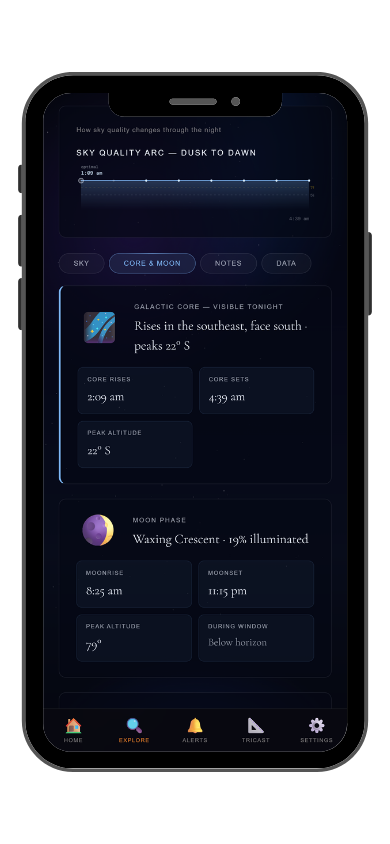
The live score above pulls today's forecast and runs it through StarCast's scoring model, factoring in cloud cover, moon illumination, Bortle class, humidity, and atmospheric transparency. Above 70 is an excellent night for astrophotography. Below 40, conditions are poor. The score updates daily.
What makes Sheridan good for astrophotography?
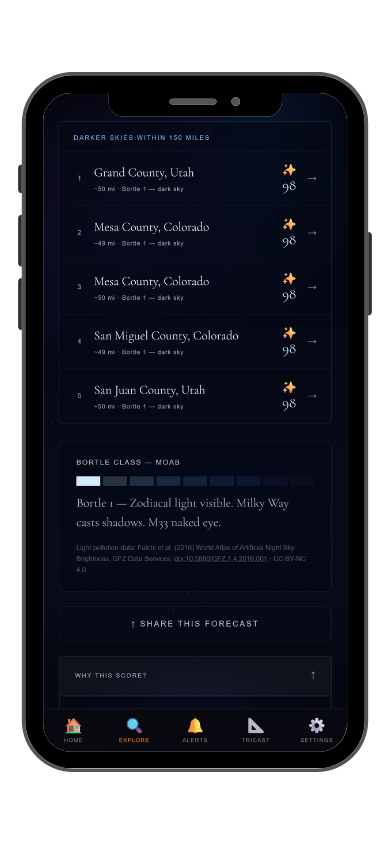
Sheridan sits at 3,700 feet at the base of the Bighorn Mountains in northern Wyoming, with Bighorn National Forest rising immediately to the west. The Bighorns top out at Cloud Peak at 13,175 feet and form a dramatic wall of granite and limestone above the plains. The Bighorn National Forest offers Bortle Class 2 to 3 skies on the mountain slopes, and the Tongue River Canyon just south of Dayton — accessible by a short forest road — is a striking canyon foreground with dark skies overhead. The plains to the east and north extend for miles with minimal population, and the Montana border to the north adds to the sense of vast, dark emptiness. Medicine Wheel National Historic Landmark, a prehistoric Native American stone circle at 9,642 feet, is one of the most culturally and photographically significant dark sky locations in Wyoming.
When is the Milky Way visible near Sheridan?
The galactic core is visible from late March through early October at Sheridan's northern Wyoming latitude. Prime astrophotography season runs May through September, with June and July offering the highest core altitude above the Bighorn Mountains. Medicine Wheel is accessible by road from mid-June through October depending on snowpack at nearly 10,000 feet. Wyoming's continental climate produces reliably dry and clear summer nights on the mountain slopes. The open plains east of Sheridan allow wide panoramic arch compositions of the Milky Way rising above the Bighorn skyline.