Frequently asked
Is tonight good for stargazing in Show Low?
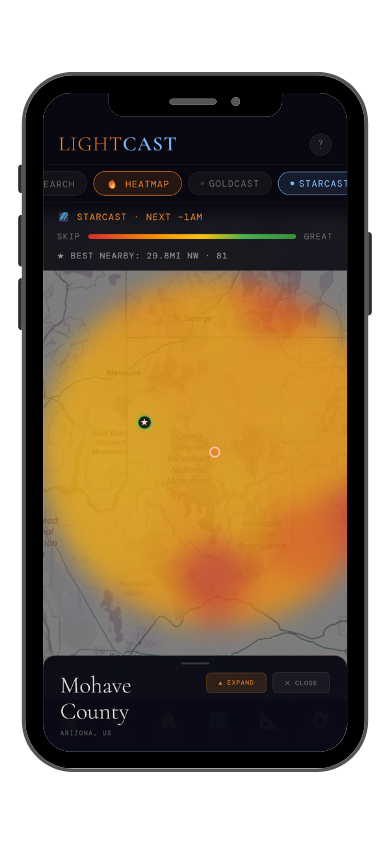
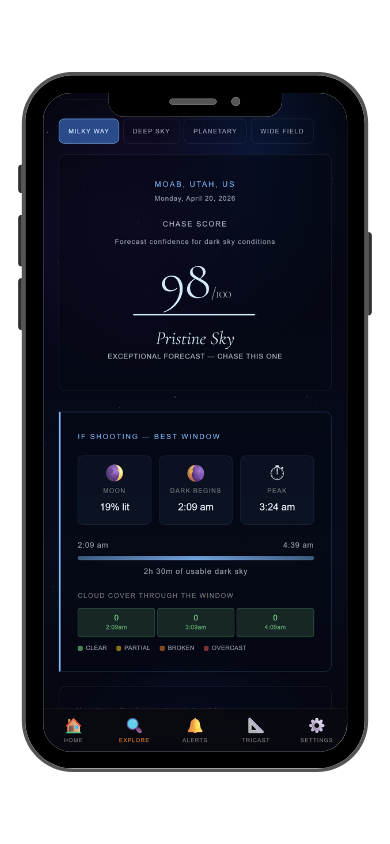
The live score above pulls today's forecast and runs it through StarCast's scoring model, factoring in cloud cover, moon illumination, Bortle class, humidity, and atmospheric transparency. Above 70 is an excellent night for astrophotography. Below 40, conditions are poor. The score updates daily.
What makes Show Low good for astrophotography?
Show Low sits at 6,300 feet on the White Mountain Plateau in eastern Arizona, one of the highest and most isolated population centers in the state. The Apache-Sitgreaves National Forest extends in all directions, and genuine Bortle Class 2 to 3 darkness is reachable within minutes of leaving the small city. The White Mountains rise to over 11,000 feet nearby, and the Mogollon Rim drops away to the south and west — giving shooters both high-elevation access and sweeping open horizons. Fort Apache Indian Reservation and the White Mountain Apache Tribe's land to the south maintain very low artificial light output, making the southeastern sky toward the galactic core remarkably dark. The altitude keeps the atmosphere thin and humidity moderate even during monsoon season.
When is the Milky Way visible in Show Low?
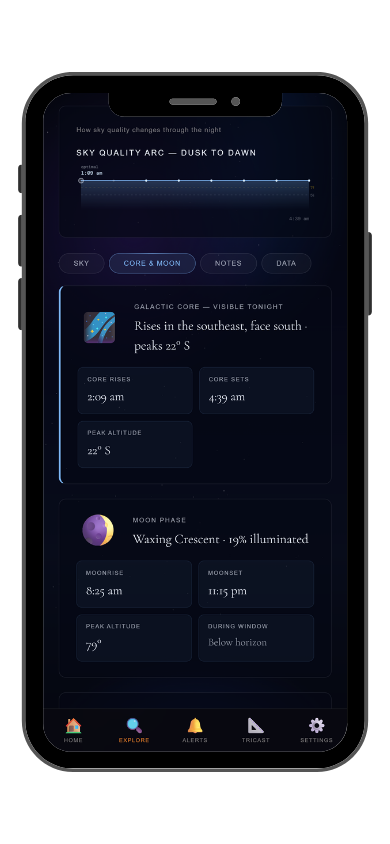
The galactic core is visible from late February through late October at Show Low's latitude. The elevated terrain and dark surrounding forest make this one of the better Milky Way platforms in Arizona outside of dedicated dark sky parks. Prime season runs May through September. Monsoon season builds convective clouds in July and August, but the high elevation means storms typically pass quickly, and the nights following storms often feature extraordinary atmospheric clarity. New moon windows in June and July deliver the best combination of core altitude and darkness duration.