Frequently asked
Is tonight good for stargazing at Siding Spring?
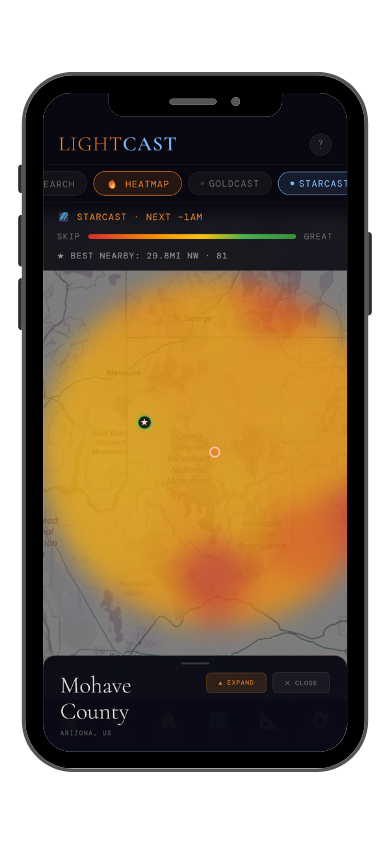
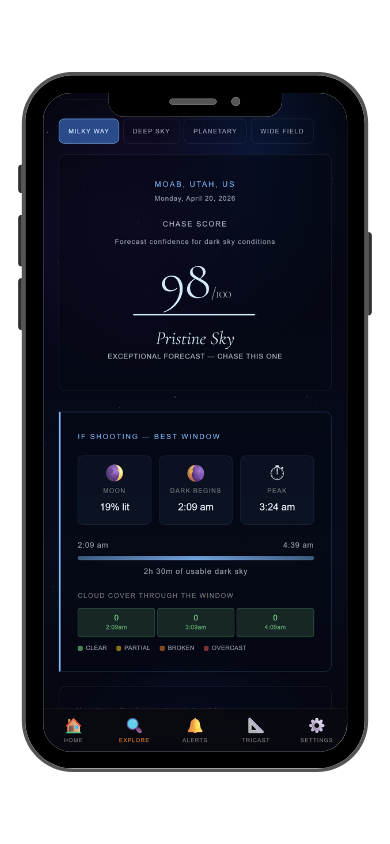
The live score above pulls today's forecast and runs it through StarCast's scoring model, factoring in cloud cover, moon illumination, Bortle class, humidity, and atmospheric transparency. Above 70 is an excellent night. Below 40, conditions are poor. The score updates daily.
What makes Siding Spring good for astrophotography?
Siding Spring Observatory on the Warrumbungle Range in central New South Wales is the site of Australia's largest optical telescope and sits within the country's only designated Dark Sky Park. The 1,165-meter elevation and surrounding national park buffer keep the skies reliably dark: Bortle Class 1 to 2 conditions are standard on clear nights. The observatory's domes and the Warrumbungle volcanic formations create foreground combinations available nowhere else in Australian astronomy. The national park campground is within a few kilometers of the observatory and gives photographers on-site dark sky access without organized tours.
When is the Milky Way visible at Siding Spring?
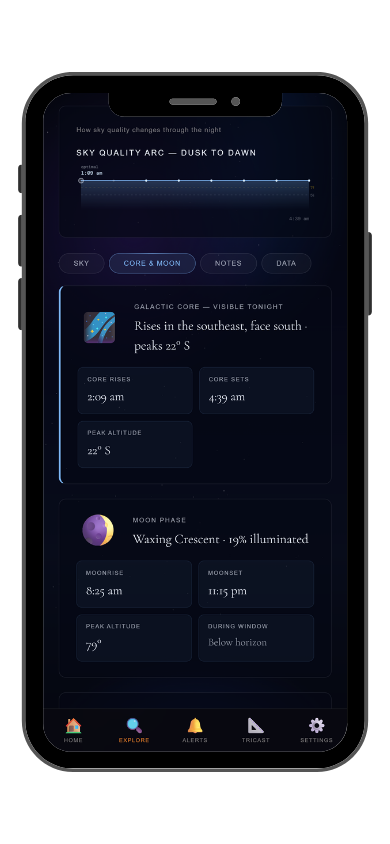
The galactic core is visible from February through October. April through September is the driest and most reliable window: the high-pressure systems that dominate inland New South Wales in winter produce cold, stable, and exceptionally clear nights. The galactic center transits nearly overhead in winter at this latitude, and the observatory domes are most dramatically lit on nights when ambient humidity is near zero and no haze is present. The Visitors Discovery Centre is open during the day and can be used to plan shooting positions around the dome complex.