Frequently asked
Is tonight good for stargazing at Simien Mountains National Park?
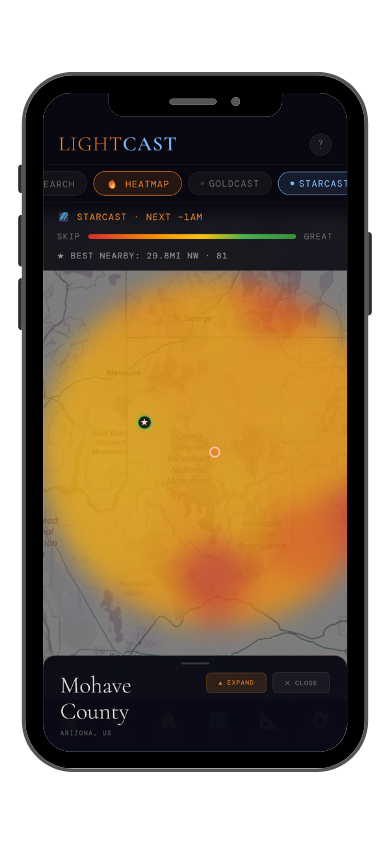
The live score above pulls today's forecast and runs it through StarCast's scoring model, factoring in cloud cover, moon illumination, Bortle class, humidity, and atmospheric transparency. Above 70 is an excellent night. Below 40, conditions are poor. The score updates daily.
What makes Simien Mountains National Park good for astrophotography?
Simien Mountains National Park in northern Ethiopia is a UNESCO World Heritage Site protecting one of Africa's highest mountain ranges, with the plateau averaging 3,000 to 4,000 meters above sea level and Ras Dashen — Ethiopia's highest peak — reaching 4,550 meters. At this extreme elevation in the Ethiopian highlands, far from any significant artificial light, the park achieves Bortle Class 1 to 2 skies of exceptional quality. The dramatic escarpment of the Simien plateau — with sheer cliffs dropping thousands of meters to the lowlands below — provides a foreground of geological grandeur. The park is also home to the gelada baboon, the Ethiopian wolf, and the Walia ibex, found nowhere else on Earth. The near-equatorial latitude places the galactic core high in the sky, and the extreme altitude delivers extraordinary atmospheric transparency.
When is the Milky Way visible at Simien Mountains National Park?
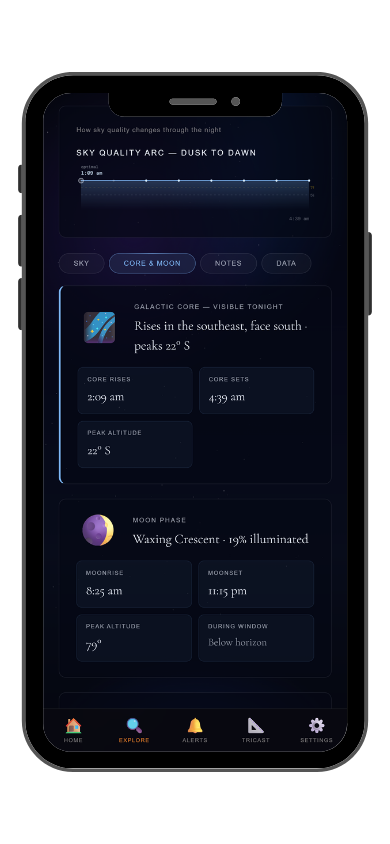
At the Simien Mountains' near-equatorial latitude, the galactic core is visible throughout the year. Ethiopia has two main seasons: the dry season from October through May and the rainy season (kiremt) from June through September. The dry season delivers clear nights of exceptional quality, while the rainy season brings heavy cloud cover that severely limits astronomy. The best window runs from October through May, with November through February particularly clear and with the galactic core in favorable positions. The extreme elevation means temperatures drop sharply after dark even in the dry season — warm layers are essential for nighttime sessions on the escarpment.