Frequently asked
Is tonight good for stargazing at Sleeping Bear Dunes?
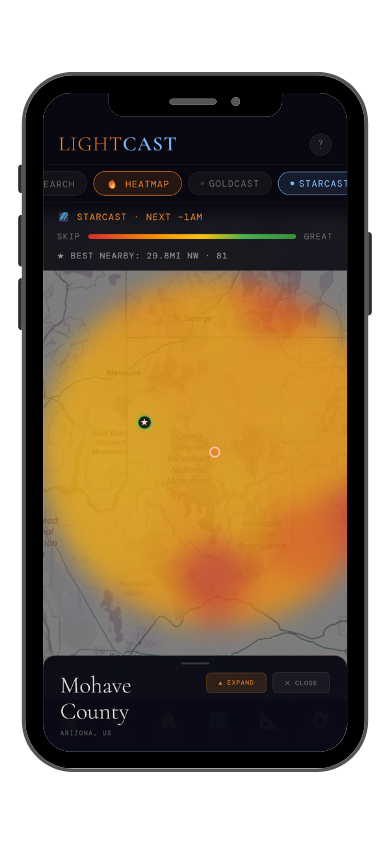
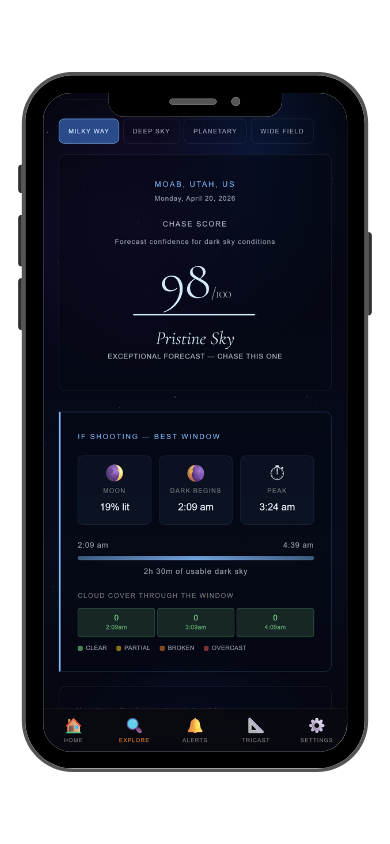
The live score above pulls today's forecast and runs it through StarCast's scoring model, factoring in cloud cover, moon illumination, Bortle class, humidity, and atmospheric transparency. Above 70 is an excellent night. Below 40, conditions are poor. The score updates daily.
What makes Sleeping Bear Dunes good for astrophotography?
Sleeping Bear Dunes National Lakeshore on the northwestern shore of Michigan's Lower Peninsula is an International Dark Sky Park, designated in 2022. The towering sand dunes along Lake Michigan face west and northwest, two of the darkest horizons available: open water in those directions means no light pollution for hundreds of miles. The Dune Climb area and Empire Bluffs are the most popular shooting positions, offering expansive westward views across the lake. The combination of ancient dune geology, hardwood forests, and open lake makes it one of the most compositionally varied dark sky parks in the Midwest.
When is the Milky Way visible at Sleeping Bear Dunes?
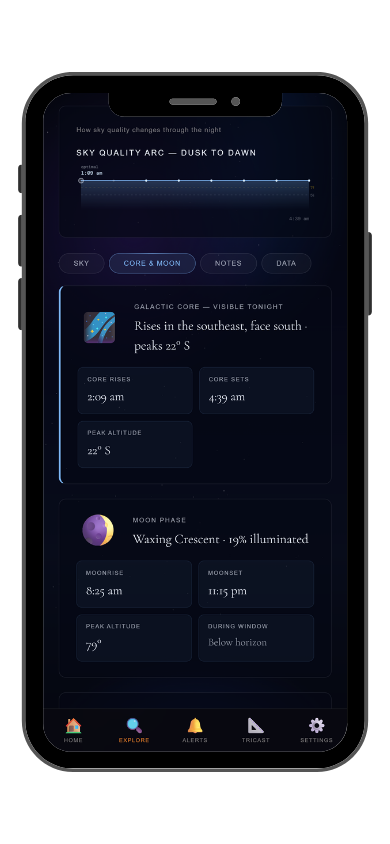
The galactic core is visible from March through October. Lake Michigan moderates temperatures, keeping nights milder than the surrounding inland areas. The core rises in the southeast and is best framed from the east-facing inland areas of the park: Empire Bluffs or the dune overlooks work for southward views. For lake-facing shots, star trails and constellation photography tend to work better than galactic core compositions, given the westward orientation. June through August sees the most stable skies.