Frequently asked
Is tonight good for stargazing at Snowdonia?
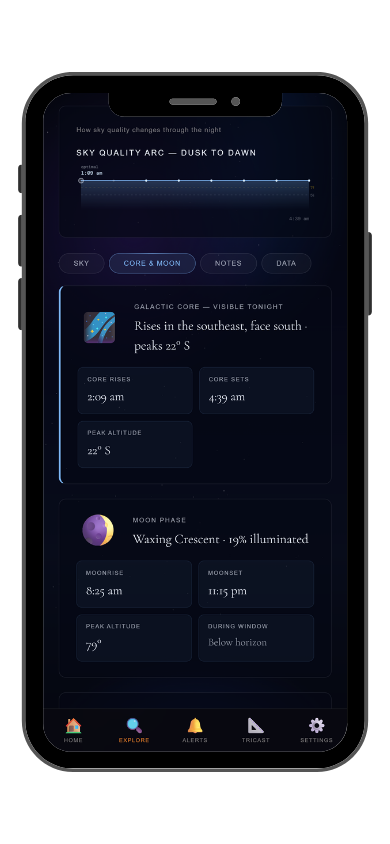
The live score above pulls today's forecast and runs it through StarCast's scoring model, factoring in cloud cover, moon illumination, Bortle class, humidity, and atmospheric transparency. Above 70 is an excellent night. Below 40, conditions are poor. The score updates daily.
What makes Snowdonia good for astrophotography?
Eryri (Snowdonia) National Park in northwest Wales is an International Dark Sky Reserve, one of only a handful in the world. The park's mountainous terrain and distance from major urban centers produce Bortle Class 2 to 3 conditions across most of the interior. Snowdon (Yr Wyddfa), Wales' highest peak at 1,085 meters, and the surrounding lakes, particularly Llyn Padarn and Llyn Gwynant, give photographers a mountain and reflective water combination rare in the British Isles. The Irish Sea to the west ensures a dark western horizon, and Liverpool and Manchester to the east are far enough that their glow is minimal above the Berwyn Mountains.
When is the Milky Way visible at Snowdonia?
The galactic core is visible from March through October. The clearest nights at Snowdonia tend to come in spring (April through May) and autumn (September through October), when Atlantic fronts pass through and clear conditions follow. Summer brings some of the region's driest weather but short nights at this latitude. Cloud is frequent year-round given the mountain terrain's interaction with Atlantic moisture, so checking the forecast and being ready to move quickly on a clear night matters more here than at continental locations.