Frequently asked
Is tonight good for stargazing at Sossusvlei?
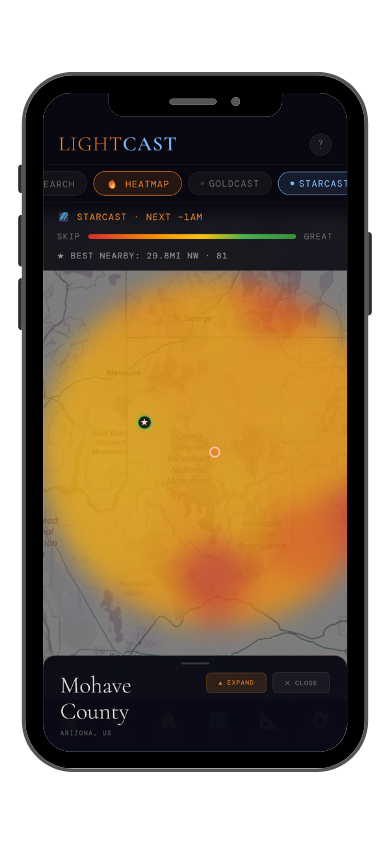
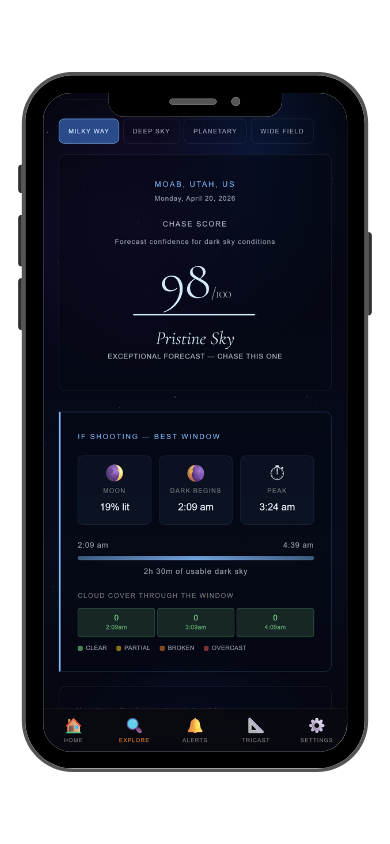
The live score above pulls today's forecast and runs it through StarCast's scoring model, factoring in cloud cover, moon illumination, Bortle class, humidity, and atmospheric transparency. Above 70 is an excellent night. Below 40, conditions are poor. The score updates daily.
What makes Sossusvlei good for astrophotography?
Sossusvlei is a salt and clay pan surrounded by some of the world's tallest sand dunes in the Namib-Naukluft National Park. The dunes rise up to 325 meters and glow deep orange and red in any available light, making them exceptional foreground whether illuminated by moonlight or starlight. The region sits within the NamibRand dark sky corridor with Bortle Class 1 skies across the entire park. Deadvlei, a dried white clay pan dotted with 900-year-old dead camel thorn trees, is one of the most otherworldly night photography foregrounds on the planet. The trees and cracked white clay against the star field make for compositions that exist nowhere else.
When is the Milky Way visible at Sossusvlei?
The galactic core is visible from February through October. May through September is the optimal window: the air is bone dry, temperatures overnight are comfortable (10 to 15°C), and the galactic center rises high overhead. The park gate opens at sunrise and closes at sunset, so overnight access to Sossusvlei itself requires staying at one of the lodges inside the park (Sossusvlei Lodge or Little Kulala). Arriving before gate opening and after closing allows shooting the dunes in astronomical darkness from the gate area, which is still within the dark sky zone.