Frequently asked
Is tonight good for stargazing at Spiral Jetty?
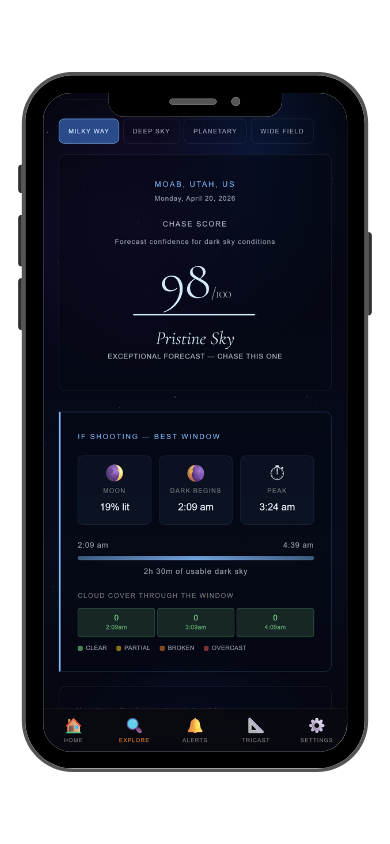
The live score above pulls today's forecast and runs it through StarCast's scoring model, which factors in cloud cover, moon illumination, Bortle class, humidity, and atmospheric transparency. Above 70 is an excellent night. Below 40, conditions are poor. The score updates daily.
What makes Spiral Jetty good for astrophotography?
Spiral Jetty is Robert Smithson's 1970 earthwork on the northern shore of the Great Salt Lake: a 1,500-foot coil of black basalt rock that spirals out into the pink-red hypersaline water. At night, the jetty's form reads clearly under starlight, and the salt lake surface reflects the sky when water levels are right. The surrounding basin is flat and dark in every direction, with no towns within close range and Bortle 3 skies. It's one of the most conceptually and visually distinctive foregrounds in American landscape photography, and almost no one photographs it at night.
When is the Milky Way visible at Spiral Jetty?
The galactic core is visible from April through October. Spring and early summer bring the best combination of Milky Way position and manageable temperatures. The access road is unpaved and can become impassable after rain: check conditions before driving out at night. Water levels in the Great Salt Lake vary year to year and affect how much of the jetty is submerged, so checking recent photos before the trip is worthwhile.