Frequently asked
Is tonight good for stargazing in St. George?
The live score above pulls today's forecast and runs it through StarCast's scoring model, factoring in cloud cover, moon illumination, Bortle class, humidity, and atmospheric transparency. Above 70 is an excellent night for astrophotography. Below 40, conditions are poor. The score updates daily.
What makes St. George good for astrophotography?
St. George is positioned at the convergence of the Mojave Desert, the Colorado Plateau, and the Great Basin — one of the most light-pollution-free corners of the American West. The city itself sits at Bortle Class 4 to 5, but within 30 to 60 minutes in almost any direction, shooters can reach Bortle Class 2 to 3 skies. Snow Canyon State Park to the northwest offers striking red sandstone canyon walls and lava fields as foreground. Zion National Park is 45 minutes away. The region sits at 2,800 feet elevation with low humidity and over 300 clear nights per year on average — exceptional for the American West. Southern Utah's red rock landscape, famous by day, becomes equally dramatic after dark when shot against the galactic core.
When is the Milky Way visible near St. George?
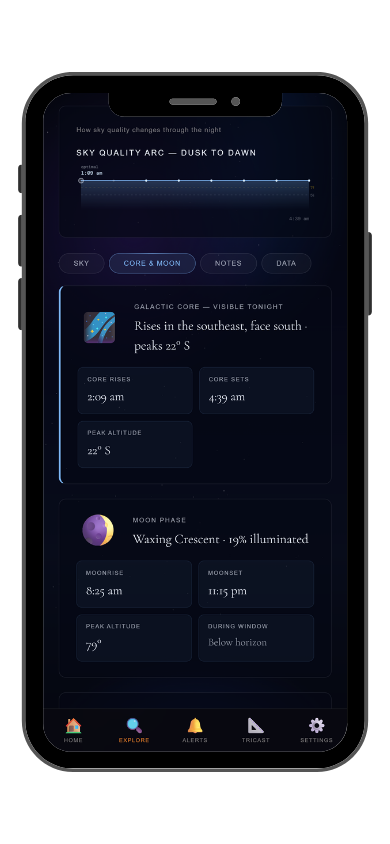
The galactic core is visible from late February through early November from this latitude, one of the longest Milky Way windows in the country. The core rises in the southeast and arcs high enough for dramatic compositions by April. The prime window for astrophotography is April through September, when the core clears the horizon early enough to shoot during astronomical darkness. St. George's low precipitation and low humidity make monsoon season — July through September — more manageable here than at higher elevations, though afternoon storms can build quickly and clear by nightfall.