Frequently asked
Is tonight good for stargazing at Steens Mountain?
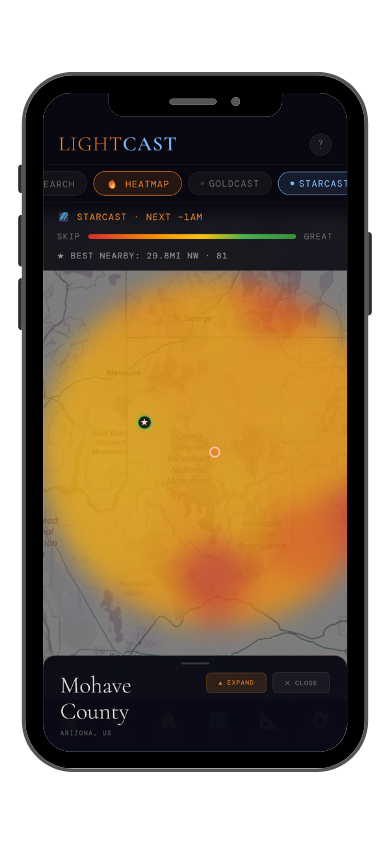
The live score above pulls today's forecast and runs it through StarCast's scoring model, factoring in cloud cover, moon illumination, Bortle class, humidity, and atmospheric transparency. Above 70 is an excellent night. Below 40, conditions are poor. The score updates daily.
What makes Steens Mountain good for astrophotography?
Steens Mountain is the highest point in Oregon's high desert at 9,733 feet. It rises sharply from the Alvord Desert below, one of the driest and most remote places in the state. The surrounding region is among the darkest in the Pacific Northwest, with Bortle Class 1 conditions across the Alvord playa directly below the mountain. The high desert climate means extremely low humidity and consistent clear skies outside the brief winter snow season. The dramatic fault-block geology creates a steep western escarpment with sweeping views toward the interior of the basin and range. The Alvord Desert playa below is flat and open in every direction, producing an unobstructed 360-degree horizon that astrophotographers prize.
When is the Milky Way visible at Steens Mountain?
The galactic core is visible from late March through October. The summit road is typically accessible from late June through October depending on snowpack. The Alvord Desert below is accessible year-round and provides some of the best Milky Way conditions in Oregon. The high desert's exceptional atmospheric transparency means the galactic core is vivid on any clear moonless night during the season.