Frequently asked
Is tonight good for stargazing in Taos Ski Valley?
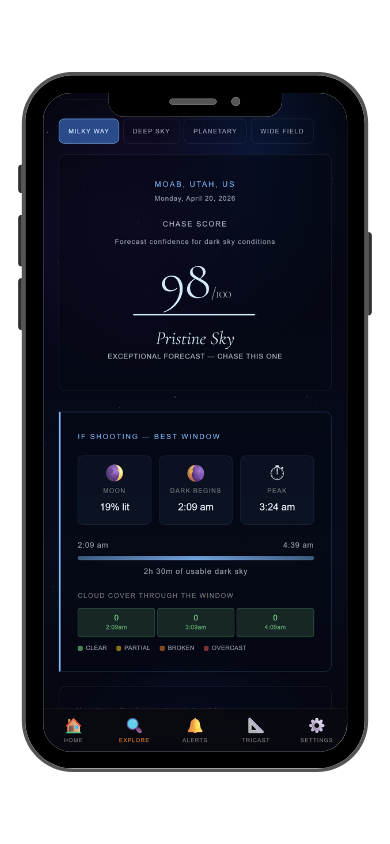
The live score above pulls today's forecast and runs it through StarCast's scoring model, factoring in cloud cover, moon illumination, Bortle class, humidity, and atmospheric transparency. Above 70 is an excellent night for astrophotography. Below 40, conditions are poor. The score updates daily.
What makes Taos Ski Valley good for astrophotography?
Taos Ski Valley sits at 9,200 feet at the base of Wheeler Peak, the highest point in New Mexico at 13,161 feet, within the Carson National Forest. This is among the highest-elevation shooting platforms in the state, with Bortle Class 2 to 3 darkness beginning right at the valley's edge. The elevation delivers thin, transparent atmosphere that dramatically improves the contrast and color rendition of the Milky Way. Wheeler Peak's summit and the surrounding Taos Mountains provide powerful high-alpine foregrounds including snowfields, alpine lakes, and rugged ridgelines. The Taos area is far from any large metropolitan area, and the wilderness that surrounds the ski valley is largely roadless — the sky above is genuinely pristine. The valley's narrow canyon orientation also blocks low-elevation light domes from the south.
When is the Milky Way visible in Taos Ski Valley?
The galactic core is visible from late March through early October at this latitude and elevation. The high-alpine environment means late spring snowpack may limit physical access to some locations until June. Prime astrophotography season runs June through September, when access is reliable and the core climbs well into the southern sky. Summer monsoon afternoons in July and August build clouds that often clear by late night at elevation, leaving exceptionally transparent post-storm skies. Winter offers long nights with outstanding clarity for deep-sky and star trail work, though temperatures at 9,000-plus feet are extreme.