Frequently asked
Is tonight good for stargazing at Telescope Peak?
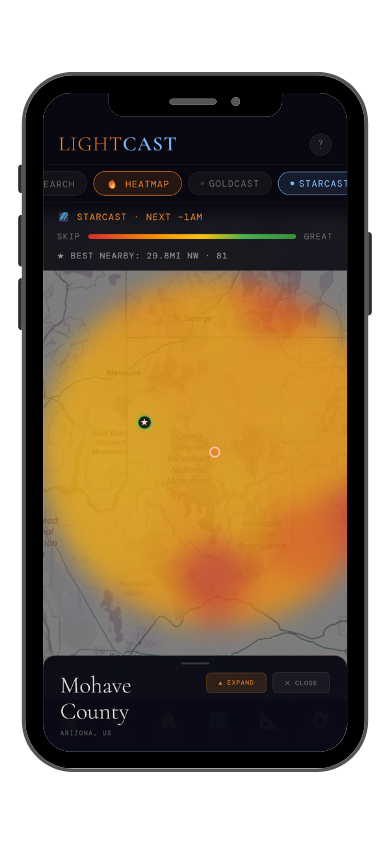
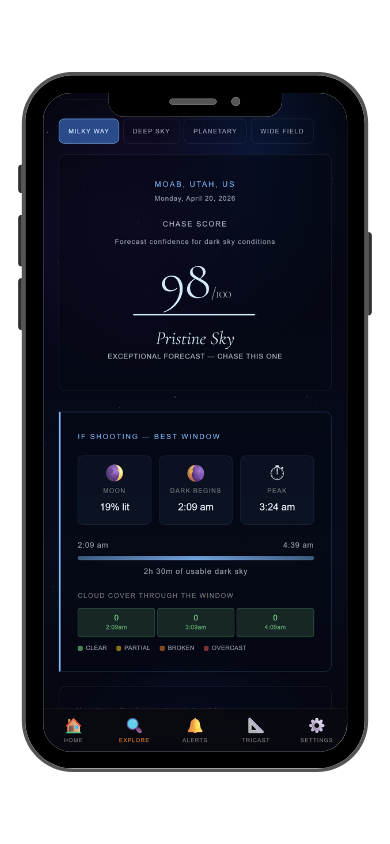
The live score above pulls today's forecast and runs it through StarCast's scoring model, factoring in cloud cover, moon illumination, Bortle class, humidity, and atmospheric transparency. Above 70 is an excellent night for astrophotography. Below 40, conditions are poor. The score updates daily.
What makes Telescope Peak good for astrophotography?
Telescope Peak tops out at 11,043 feet as the highest point in Death Valley National Park, which carries Gold Tier International Dark Sky Park status, the highest darkness rating available. From the summit on a clear day you can see Badwater Basin, the lowest point in North America at 282 feet below sea level, and on the clearest days even Mount Whitney, the highest peak in the contiguous US, both from the same vantage point, a vertical range unmatched anywhere else in the country. That extreme elevation above the valley floor puts skies here at roughly Bortle Class 1, among the darkest and most transparent conditions available in California.
When is the Milky Way visible at Telescope Peak?
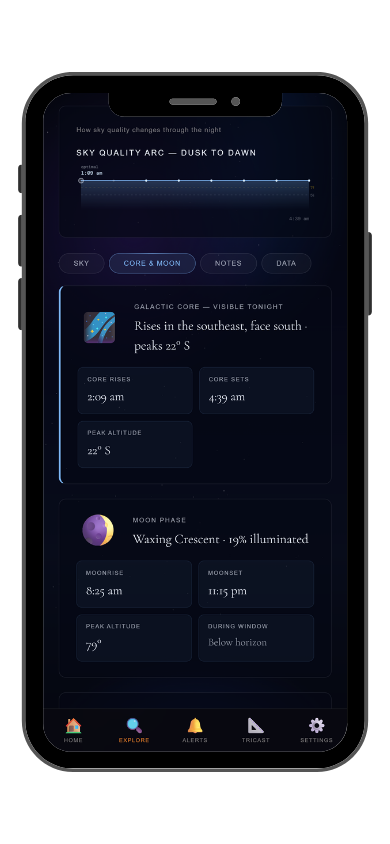
The core is visible from late February through October. The summit trail, a strenuous roughly 14 mile round trip, is typically snow-covered from late fall through spring, so June through September is the realistic window for reaching the top itself. Nights on the summit are cold even in summer given the elevation, so this is a serious backcountry outing rather than a roadside shoot.