Frequently asked
Is tonight good for stargazing in Terlingua?
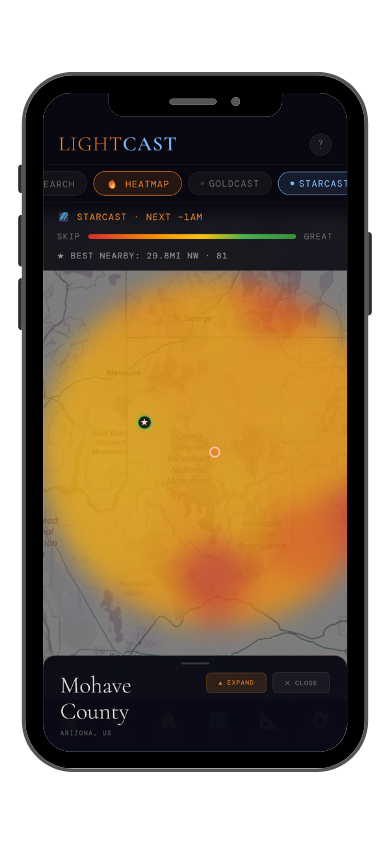
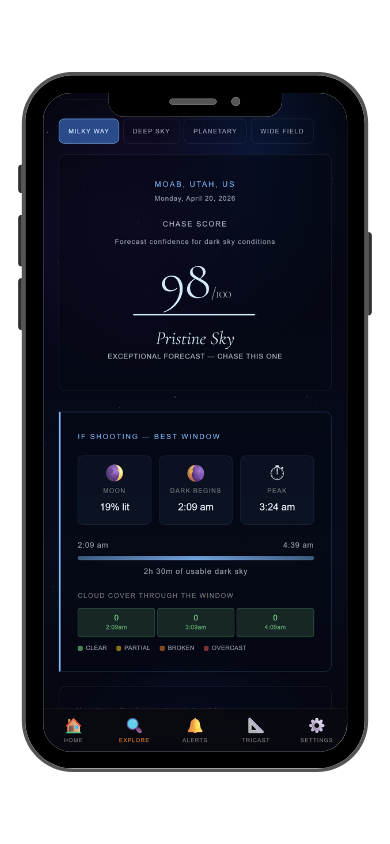
The live score above pulls today's forecast and runs it through StarCast's scoring model, factoring in cloud cover, moon illumination, Bortle class, humidity, and atmospheric transparency. Above 70 is an excellent night for astrophotography. Below 40, conditions are poor. The score updates daily.
What makes Terlingua good for astrophotography?
Terlingua is a former mercury-mining ghost town on the western edge of Big Bend National Park in far West Texas. The park is a certified International Dark Sky Park, and readings taken in the backcountry rank among the darkest measured in the lower 48, Bortle Class 1 to 2. Terlingua's own skies stay close to that darkness since the town has no significant lighting infrastructure. The Chisos Mountains rise to the east, and Santa Elena Canyon, where the Rio Grande cuts a 1,500 foot slot through limestone, sits about 30 minutes south, giving photographers a striking foreground for wide compositions. The high desert elevation, around 2,800 feet, and low humidity keep the air unusually transparent for long-exposure work most of the year.
When is the Milky Way visible from Terlingua?
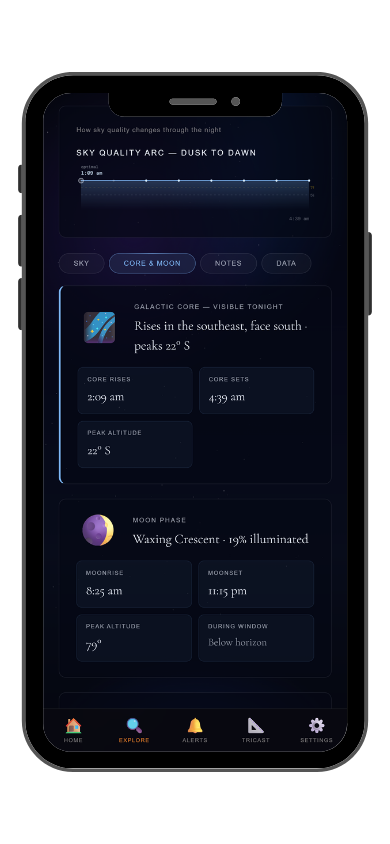
The galactic core clears the horizon from late February through October at Terlingua's southern latitude, one of the longest windows in the continental US. Prime shooting season is April through June, when nights are still dry and cool before summer monsoon storms move through the Big Bend region in July and August. Winter delivers the clearest, driest air of the year but the core is below the horizon, so it's better suited to deep sky and wide constellation work.