Frequently asked
Is tonight good for stargazing at Teton Village?
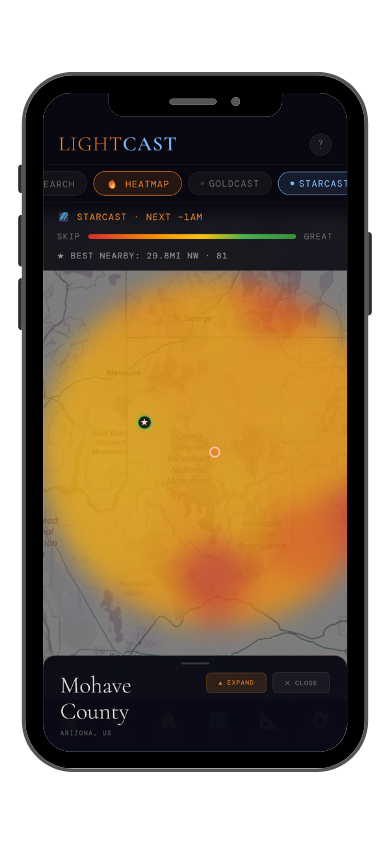
The live score above pulls today's forecast and runs it through StarCast's scoring model, factoring in cloud cover, moon illumination, Bortle class, humidity, and atmospheric transparency. Above 70 is an excellent night. Below 40, conditions are poor. The score updates daily.
What makes Teton Village good for astrophotography?
Teton Village sits at the base of Jackson Hole Mountain Resort at 6,311 feet, immediately adjacent to the western boundary of Grand Teton National Park. The village is the most accessible gateway to some of the most dramatic mountain-and-night-sky foreground in North America. The Teton Range rises directly above the village to over 13,000 feet, giving photographers a wall of jagged peaks against the Milky Way with virtually no driving required from the resort area. The Jackson Hole Aerial Tram operates in summer and provides elevated access to Rendezvous Mountain at 10,450 feet for high-altitude nighttime shooting on special event nights. The Snake River plain to the east and south offers open reflective water foregrounds away from the mountain mass.
When is the Milky Way visible at Teton Village?
The galactic core is visible from April through October, with the core rising behind the Teton peaks in the southwest from June through August for the signature composition in this area. The Jackson Hole valley floor is at high elevation and nights cool dramatically even in midsummer, so warm layers are essential. Jackson itself has a moderate light dome to the south, but shooting northwest toward the peaks minimizes its impact entirely. Fall brings the earliest true darkness and thinner crowds after the summer visitor peak.