Frequently asked
Is tonight good for stargazing at Theodore Roosevelt?
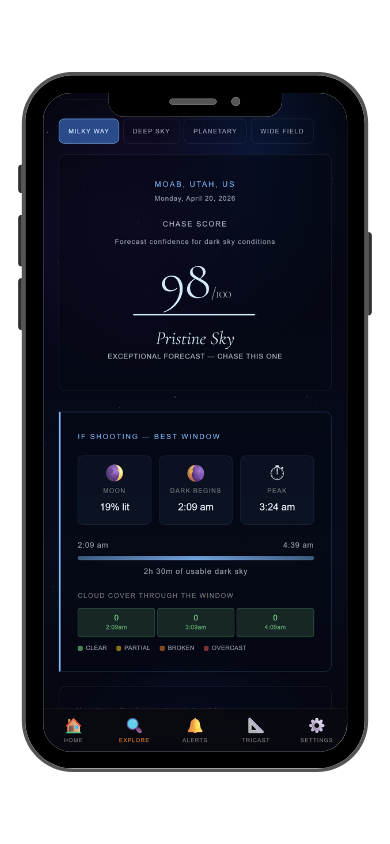
The live score above pulls today's forecast and runs it through StarCast's scoring model, factoring in cloud cover, moon illumination, Bortle class, humidity, and atmospheric transparency. Above 70 is an excellent night. Below 40, conditions are poor. The score updates daily.
What makes Theodore Roosevelt good for astrophotography?
Theodore Roosevelt National Park in western North Dakota sits under Bortle Class 3 skies in one of the most sparsely populated regions of the Great Plains. The park's badlands terrain, carved from colorful sedimentary layers by the Little Missouri River, provides unusual foreground: banded buttes, petrified wood, and open river valleys that look otherworldly under a star-filled sky. The park hosts a popular annual star party each September drawing serious astrophotographers from across the region. Beef Corral Bottom in the South Unit and the Oxbow Overlook in the North Unit are the most frequently used astrophotography positions. The North Dakota latitude also puts this park in a position to see the aurora borealis during active geomagnetic events.
When is the Milky Way visible at Theodore Roosevelt?
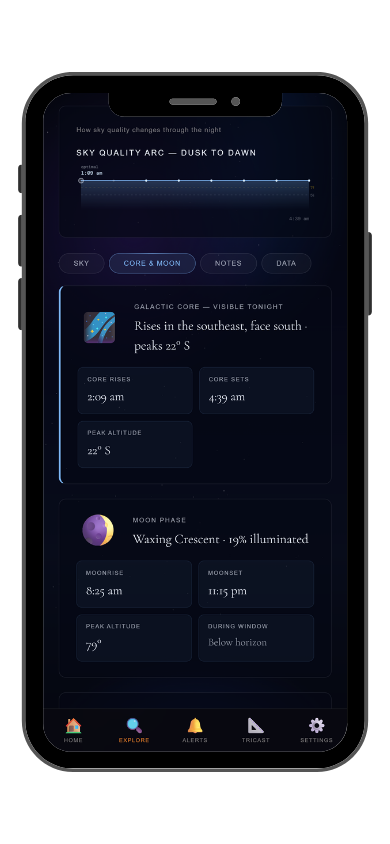
The galactic core is visible from April through October, with peak from June through August. The high plains climate delivers consistently clear skies and relatively low humidity compared to eastern states. Summer nights are short at this latitude, so the darkest window is concentrated between about midnight and 3 AM. The annual Okie-Tex adjacent star party in September draws the largest crowds. Aurora viewing is possible from fall through spring.