Frequently asked
Is tonight good for stargazing at Tromsø?
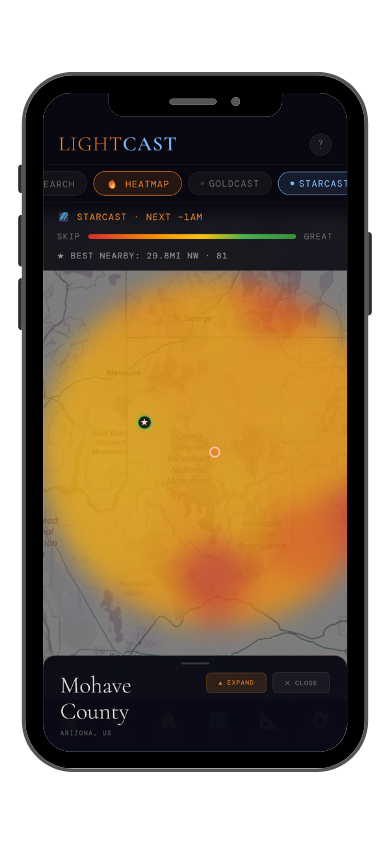
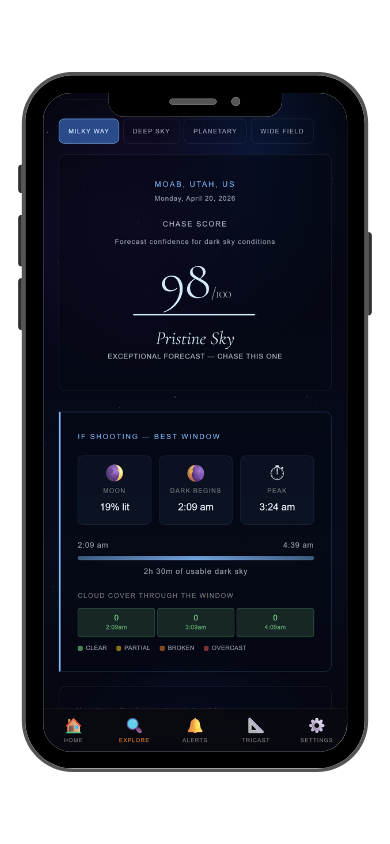
The live score above pulls today's forecast and runs it through StarCast's scoring model, factoring in cloud cover, moon illumination, Bortle class, humidity, and atmospheric transparency. Above 70 is an excellent night. Below 40, conditions are poor. The score updates daily.
What makes Tromsø good for astrophotography?
Tromsø is the largest city north of the Arctic Circle and the primary base for aurora photography in northern Norway. The city itself has enough light to limit dark sky quality at ground level, but the surrounding fjords and mountains within 30 to 60 minutes by road drop into genuine darkness: the Lyngen Alps to the east and the fjord islands to the west are both accessible and reliably dark. Tromsø sits directly beneath the center of the auroral oval, giving it among the highest aurora frequency of any easily accessible destination in the world. The combination of accessible flights, accommodation, and nearby dark terrain makes it the entry point for most first-time aurora photographers.
When is the Milky Way visible at Tromsø?
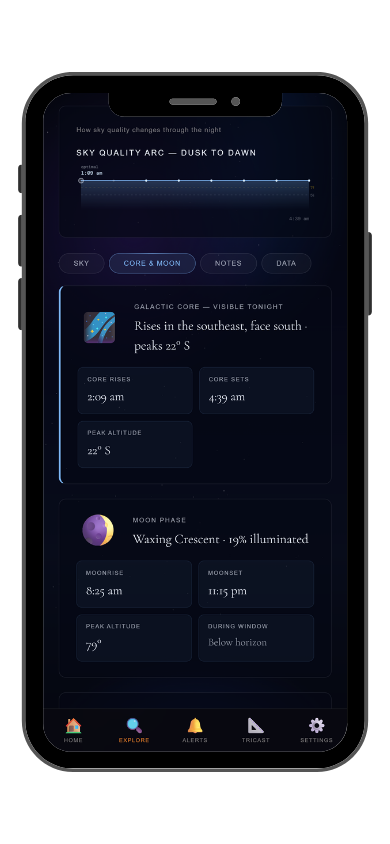
The Milky Way galactic core is not a practical target at Tromsø's latitude of 69.6 degrees north. The core stays below or very near the southern horizon even in the best months. The night sky draw here is exclusively aurora: darkness returns in late August, and the season runs through mid-April. The polar night (no sun above the horizon) runs from late November through mid-January, giving 24-hour darkness and maximum aurora viewing opportunity. The Lyngen Alps and Ersfjordbotn are the standard dark sky positions outside the city for aurora chasing.