Frequently asked
Is tonight good for stargazing in Tusayan?
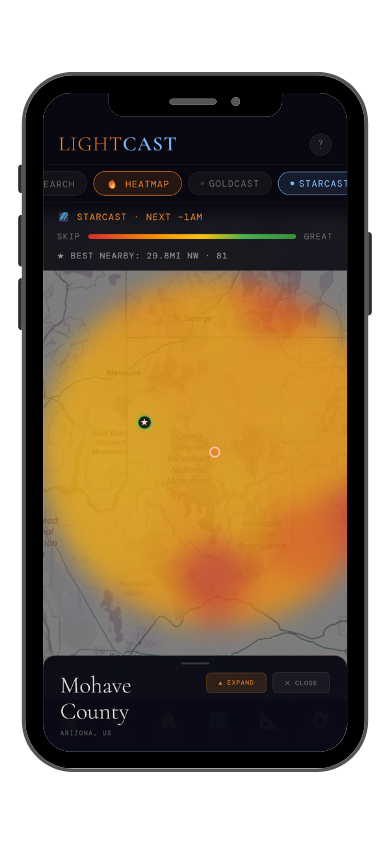
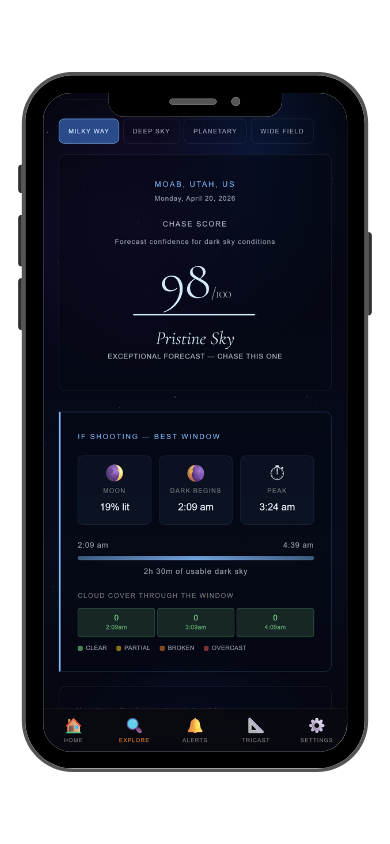
The live score above pulls today's forecast and runs it through StarCast's scoring model, factoring in cloud cover, moon illumination, Bortle class, humidity, and atmospheric transparency. Above 70 is an excellent night for astrophotography. Below 40, conditions are poor. The score updates daily.
What makes Tusayan good for astrophotography?
Tusayan sits right outside the South Rim entrance to Grand Canyon National Park, a certified International Dark Sky Park and one of the most photographed night skies in the country. The park interior reaches Bortle Class 2, and Tusayan's own skies stay close to that despite being the gateway town. Sitting at nearly 7,000 feet, the air here is thin and dry, which sharpens star points and reduces atmospheric distortion. The canyon itself, a mile deep and 18 miles across at its widest, gives photographers a foreground scale that no other US dark sky location can match.
When is the Milky Way visible near Tusayan?
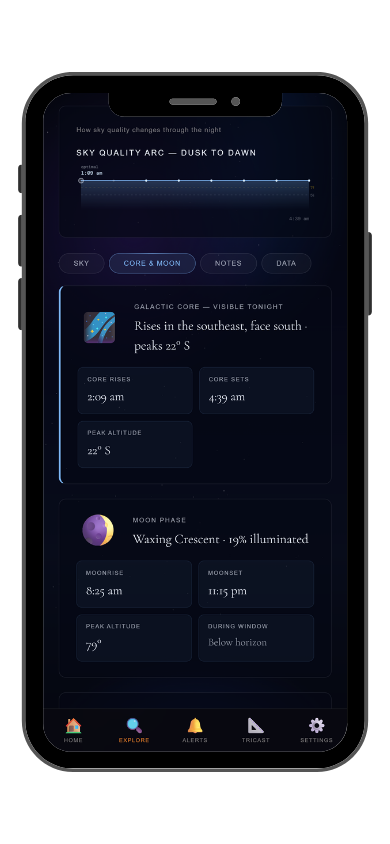
The core is visible from March through October. May and June are typically the clearest and driest months, right before the North American monsoon brings afternoon thunderstorms and higher humidity across northern Arizona in July and August. Fall shooting in September and October often delivers calm, transparent skies once the monsoon pattern breaks.