Frequently asked
Is tonight good for stargazing at Uluru?
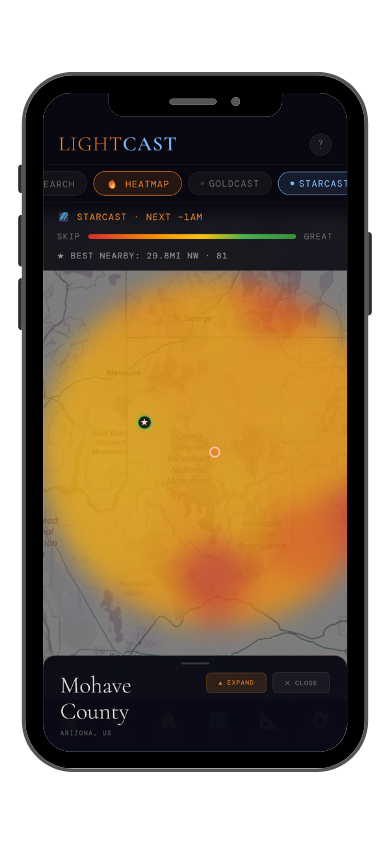
The live score above pulls today's forecast and runs it through StarCast's scoring model, factoring in cloud cover, moon illumination, Bortle class, humidity, and atmospheric transparency. Above 70 is an excellent night. Below 40, conditions are poor. The score updates daily.
What makes Uluru good for astrophotography?
Uluru-Kata Tjuta National Park sits in the Red Centre of Australia, one of the most geographically isolated regions on Earth. Alice Springs is 450 kilometers to the north and produces a negligible light dome at the rock. The surrounding flat desert gives a 360-degree unobstructed horizon at ground level, and the 348-meter sandstone monolith changes color dramatically from red to deep purple as the sky darkens at dusk. Bortle Class 1 conditions are typical on clear nights, and the Southern Hemisphere sky above the Red Centre is exceptional, with the galactic center rising nearly overhead in winter and the Large and Small Magellanic Clouds visible to the south.
When is the Milky Way visible at Uluru?
The galactic core is visible from February through October. The driest and clearest months in the Red Centre fall between May and September, which aligns with peak Milky Way season. Winter nights are cold by desert standards, occasionally dropping below 5°C overnight, but are reliably dry and clear. Summer (November through February) brings monsoonal cloud and heat, though the core is visible on clear evenings. The official viewing areas around the base of the rock are accessible until sunset only: photography from outside the cultural boundary is permitted, and sunrise and sunset positions give the best alignment of the monolith with the galactic core.