Frequently asked
Is tonight good for stargazing at Valles Caldera?
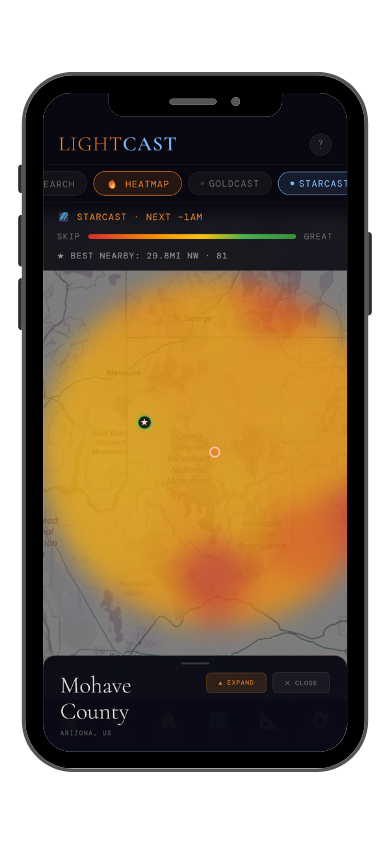
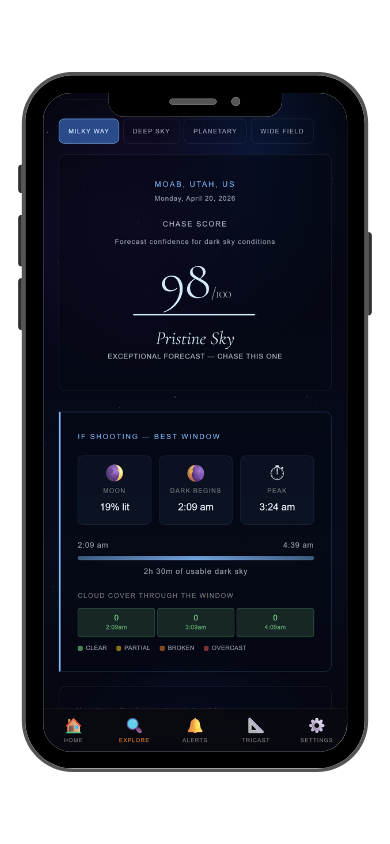
The live score above pulls today's forecast and runs it through StarCast's scoring model, factoring in cloud cover, moon illumination, Bortle class, humidity, and atmospheric transparency. Above 70 is an excellent night for astrophotography. Below 40, conditions are poor. The score updates daily.
What makes Valles Caldera good for astrophotography?
Valles Caldera National Preserve sits inside a 13-mile-wide supervolcano caldera in New Mexico's Jemez Mountains, roughly 8,500 feet above sea level. Its centerpiece, Valle Grande, is a vast, treeless meadow ringed by forested resurgent domes, giving photographers a rare unobstructed 360-degree horizon in mountain terrain. The preserve sits far enough from Los Alamos, Santa Fe, and Albuquerque that skies remain Bortle Class 2, and elk herds frequently move across the valley floor at dawn and dusk, adding wildlife interest to wide-field compositions.
When is the Milky Way visible at Valles Caldera?
The galactic core is visible from March through October at Valles Caldera's latitude, with peak viewing May through September when the core tracks directly over the caldera rim and Valle Grande's open meadow. The preserve's high elevation and dry mountain air produce steady, low-turbulence skies through summer monsoon breaks. Nights are cold year-round at 8,500 feet, and the preserve has restricted hours, so check gate times before planning a late-night shoot.