Frequently asked
Is tonight good for stargazing at Valley of Dreams?
The live score above pulls today's forecast and runs it through StarCast's scoring model, factoring in cloud cover, moon illumination, Bortle class, humidity, and atmospheric transparency. Above 70 is an excellent night. Below 40, conditions are poor. The score updates daily.
What makes Valley of Dreams good for astrophotography?
Valley of Dreams is a remote section of badlands in the Ah-Shi-Sle-Pah Wilderness Study Area of northwestern New Mexico, adjacent to the Bisti Badlands. The formations here include some of the most photogenic hoodoos and balanced rocks in the Southwest, known to photographers as the 'mushroom rocks' or 'alien eggs.' Access requires a short cross-country hike across flat desert with no marked trails. Light pollution is minimal: Farmington is 30 miles north and produces only a small glow on the horizon. Bortle Class 2 skies are common, and the wide flat terrain gives an unobstructed 360-degree view.
When is the Milky Way visible at Valley of Dreams?
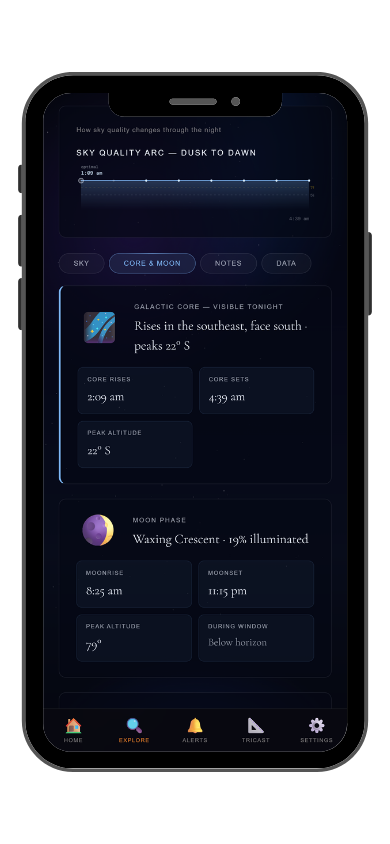
The galactic core is visible from March through October. The area gets very little visitation even during peak summer months, which means genuinely dark and quiet nights. The core rises in the southeast and by midsummer transits nearly overhead, giving the hoodoo formations an arc of Milky Way above them when compositions are planned from the north side. Bring extra water and a detailed offline map: there are no facilities and cell service is sparse.