Frequently asked
Is tonight good for stargazing in Vernal?
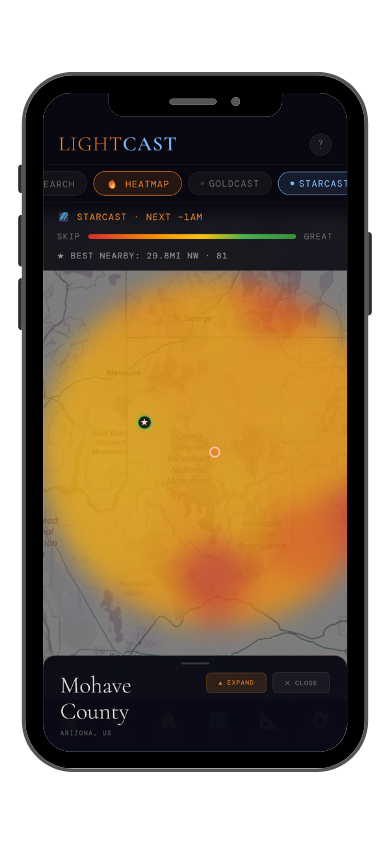
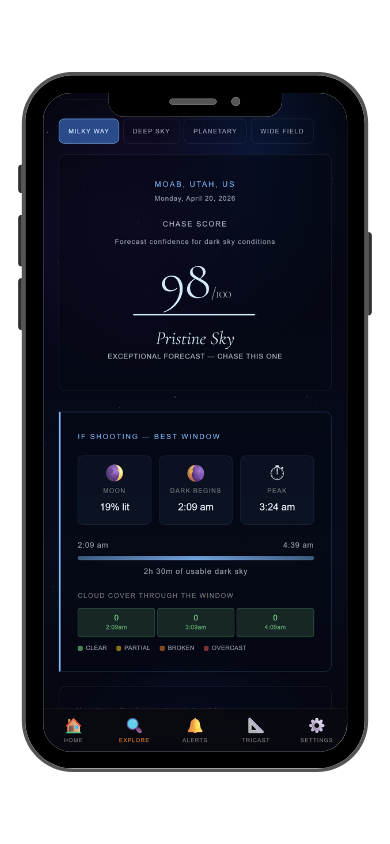
The live score above pulls today's forecast and runs it through StarCast's scoring model, factoring in cloud cover, moon illumination, Bortle class, humidity, and atmospheric transparency. Above 70 is an excellent night for astrophotography. Below 40, conditions are poor. The score updates daily.
What makes Vernal good for astrophotography?
Vernal sits at 5,300 feet in the Uinta Basin of northeastern Utah, serving as the gateway to Dinosaur National Monument and the Uinta Mountains. Dinosaur National Monument straddles the Utah-Colorado border and encompasses the deep canyons of the Green and Yampa rivers — some of the most remote river canyon country in the lower 48. The monument's canyon rims offer Bortle Class 2 skies with steep canyon walls and ancient petroglyphs as foreground. The Uinta Mountains to the north — the only major range in the lower 48 that runs east-west rather than north-south — rise to over 13,000 feet and are among the least light-polluted ranges in the Rockies. Vernal's town itself is small enough that dark skies begin just outside its borders, and the surrounding Uinta Basin has minimal population density.
When is the Milky Way visible near Vernal?
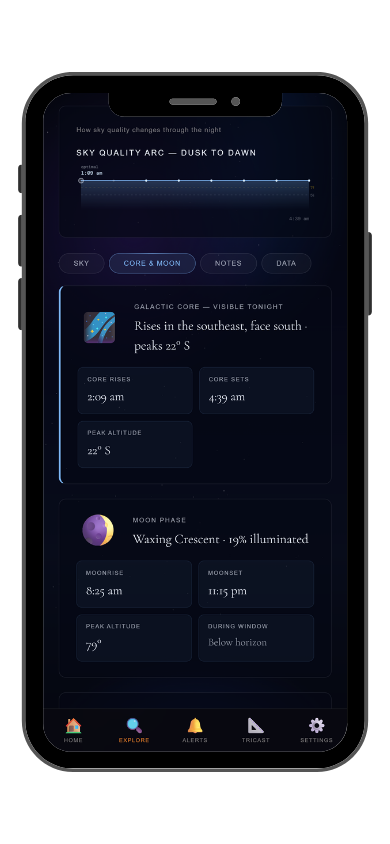
The galactic core is visible from late March through early October at Vernal's latitude. The prime shooting window runs May through September. Dinosaur National Monument's Harper's Corner and Echo Park areas are the most dramatic nearby astrophotography locations, requiring a longer drive but rewarding with exceptional canyon foreground and genuine darkness. The Uinta Mountains to the north offer alpine lake and ridgeline foregrounds in summer. Utah's high desert climate around Vernal means low annual precipitation and reliable summer nights — one of the more dependable dark sky locations in the Intermountain West.