Frequently asked
Is tonight good for stargazing at Wadi Rum?
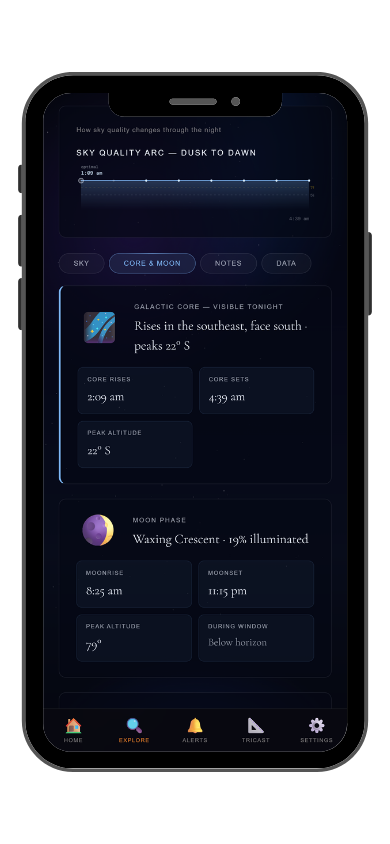
The live score above pulls today's forecast and runs it through StarCast's scoring model, factoring in cloud cover, moon illumination, Bortle class, humidity, and atmospheric transparency. Above 70 is an excellent night. Below 40, conditions are poor. The score updates daily.
What makes Wadi Rum good for astrophotography?
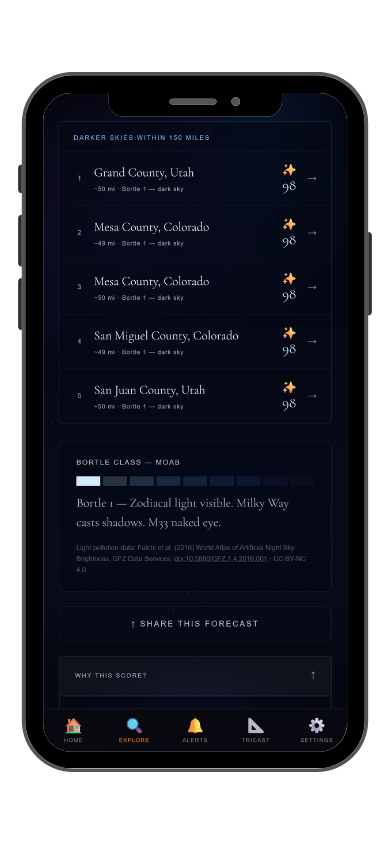
Wadi Rum in southern Jordan is a UNESCO World Heritage Site, a vast desert valley cut through sandstone and granite where towering 600-meter rock formations rise from a flat, sandy floor. The desert climate is hyperarid: humidity regularly drops below 10 percent at night, and cloud cover is rare for most of the year. Aqaba is 60 kilometers to the southwest but small enough that its glow barely reaches the interior. The surrounding desert in every direction is empty, and Bortle Class 1 to 2 conditions are typical on clear nights. The rose-red rock formations, filming locations for multiple major films, make for dramatic silhouette foreground against the Milky Way.
When is the Milky Way visible at Wadi Rum?
The galactic core is visible from March through October. Spring (March through May) and autumn (September through November) are the most comfortable seasons for overnight camping: temperatures drop to 10 to 15°C at night, skies are clear and stable, and the core is well-positioned in the south. Summer brings extreme daytime heat (40°C+), but nights cool rapidly in the desert and are still clear and photographable. Overnight Bedouin camp stays inside the protected area are the standard format for night photography access, and many operators actively support astrophotography guests.