Frequently asked
Is tonight good for stargazing at Warrumbungle?
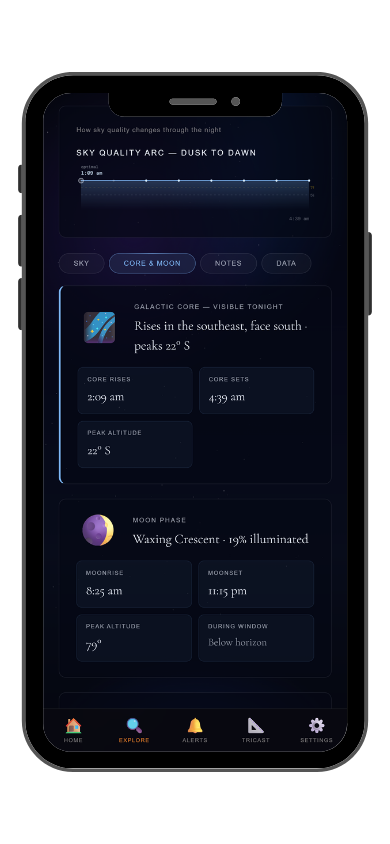
The live score above pulls today's forecast and runs it through StarCast's scoring model, factoring in cloud cover, moon illumination, Bortle class, humidity, and atmospheric transparency. Above 70 is an excellent night. Below 40, conditions are poor. The score updates daily.
What makes Warrumbungle good for astrophotography?
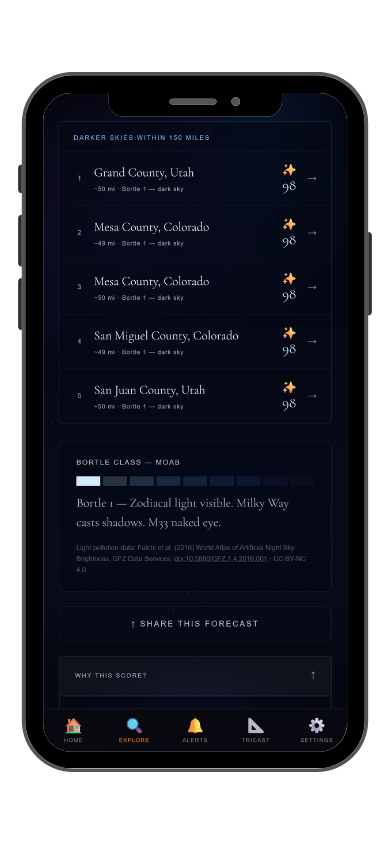
Warrumbungle National Park in central New South Wales is Australia's only Dark Sky Park, designated in 2016. It's home to Siding Spring Observatory, the site of Australia's largest optical telescope, which was chosen specifically for its sky quality: the surrounding plains produce minimal light scatter and the atmosphere above the Warrumbungle Range is exceptionally stable. The park's volcanic plugs, domes, and spires, including the Breadknife, provide dramatic foreground that's unusual for inland New South Wales. Coonabarabran to the east is small and dark-sky conscious, keeping local light impact low.
When is the Milky Way visible at Warrumbungle?
The galactic core is visible from February through October. The clearest and driest nights typically fall between April and September. The galactic center transits nearly overhead at this latitude, giving strong compositions above the volcanic formations. Summer can bring heat and occasional inland storm activity, but winter nights are cold and crystal clear. The park campground and canyon areas give easy access to dark positions within minutes of setting up.