Frequently asked
Is tonight good for stargazing at White Pocket?
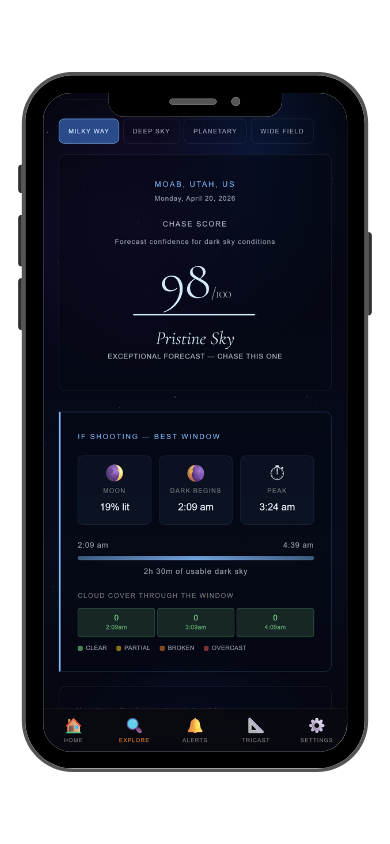
The live score above pulls today's forecast and runs it through StarCast's scoring model, factoring in cloud cover, moon illumination, Bortle class, humidity, and atmospheric transparency. Above 70 is an excellent night. Below 40, conditions are poor. The score updates daily.
What makes White Pocket good for astrophotography?
White Pocket sits inside the Vermilion Cliffs National Monument in northern Arizona, accessible only by high-clearance 4WD on sandy desert tracks. The remoteness is the point: this is one of the least-visited and darkest locations in the American Southwest, with Bortle 1 conditions and no light pollution in any direction. The swirling, brain-rock sandstone formations and white slickrock domes are unlike any other landscape in the region, and they photograph spectacularly under the Milky Way. The isolation means genuinely dark skies and near-total silence.
When is the Milky Way visible at White Pocket?
The galactic core is visible from March through October. Access requires a high-clearance 4WD vehicle and navigation via GPS — there are no signs. The sandy approach road can be impassable after rain. Spring and fall are the most reliable access seasons; summer monsoons can close the route. Camping overnight is the practical approach for serious night sky photography, as the drive in takes 45 to 90 minutes from the nearest paved road.