Frequently asked
Is tonight good for stargazing in Whitefish?
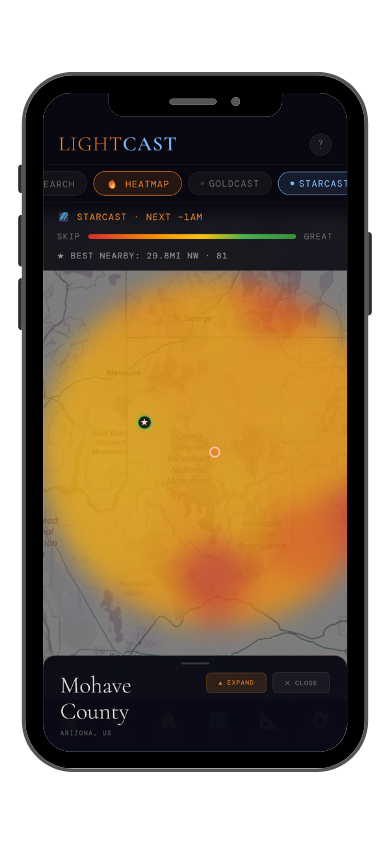
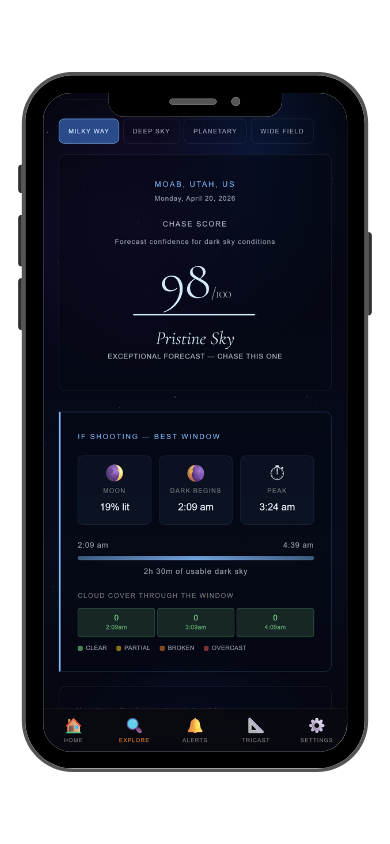
The live score above pulls today's forecast and runs it through StarCast's scoring model, factoring in cloud cover, moon illumination, Bortle class, humidity, and atmospheric transparency. Above 70 is an excellent night for astrophotography. Below 40, conditions are poor. The score updates daily.
What makes Whitefish good for astrophotography?
Whitefish sits at 3,000 feet in the Flathead Valley of northwestern Montana, at the gateway to Glacier National Park. Whitefish Lake in the center of town provides immediate reflection foreground, and Glacier National Park — 25 miles to the east — is one of the premier astrophotography destinations in the American West, with Bortle Class 2 conditions throughout its backcountry and iconic alpine lake and peak foregrounds. Lake McDonald, St. Mary Lake, Swiftcurrent Lake, and the Garden Wall ridgeline are all celebrated Milky Way photography locations. Glacier's dark sky conditions combined with the jagged Lewis Range peaks create compositions that rival any mountain dark sky location in the country. At this northern Montana latitude, the Milky Way arcs dramatically across the sky in summer, and aurora photography is a realistic goal from late August through spring. The Flathead National Forest extends dark terrain in all directions outside the park.
When is the Milky Way visible near Whitefish?
The galactic core is visible from approximately late March through early October, though the very short nights of June at 48 degrees north compress the window of astronomical darkness in midsummer. The best Milky Way astrophotography window near Whitefish is May and then late August through September, when nights are long enough and the core is well-positioned. September is particularly productive: astronomical darkness extends meaningfully, the core is still visible in the early evening, fall colors begin in the park, and aurora season is underway. Glacier's Going-to-the-Sun Road is typically open from late May through October, providing high-elevation access to Logan Pass at 6,646 feet.