Frequently asked
Is tonight good for stargazing at Wrangell-St. Elias?
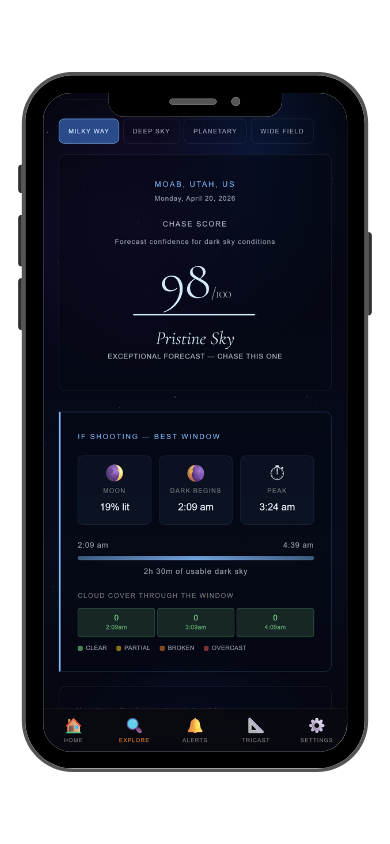
The live score above pulls today's forecast and runs it through StarCast's scoring model, factoring in cloud cover, moon illumination, Bortle class, humidity, and atmospheric transparency. Above 70 is an excellent night. Below 40, conditions are poor. The score updates daily.
What makes Wrangell-St. Elias good for astrophotography?
Wrangell-St. Elias is the largest national park in the United States, covering more than 13 million acres in eastern Alaska. It was designated an International Dark Sky Park by DarkSky International in 2018. The park sits under Bortle Class 1 skies, the darkest classification possible. The nearest significant city, Anchorage, is over 200 miles away. The park contains four major mountain ranges including the Saint Elias Mountains, with peaks reaching 18,008 feet, providing dramatic foreground options. McCarthy and Kennecott are the only road-accessible communities inside the park. This is a genuinely wilderness destination with limited infrastructure, but the reward is sky darkness found in very few other accessible places in North America.
When is the Milky Way visible at Wrangell-St. Elias?
The galactic core is visible from approximately March through September, but Alaska's summer brings near-continuous daylight that limits true dark sky windows. Late August through October is often the best window, combining a visible galactic core, actual nighttime darkness, and increasing aurora activity. Winter offers spectacular aurora photography from October through March, with the sun setting mid-afternoon and the aurora frequently active at high KP levels. Winter access requires serious preparation and typically snowmobile or aircraft.