Frequently asked
Is tonight good for stargazing at Yellowstone?
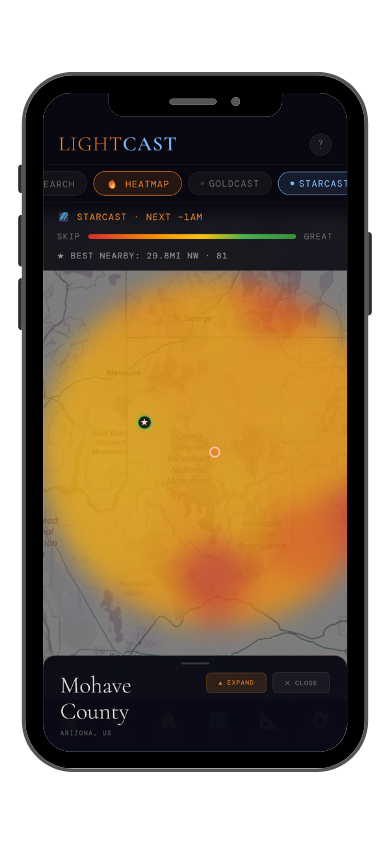
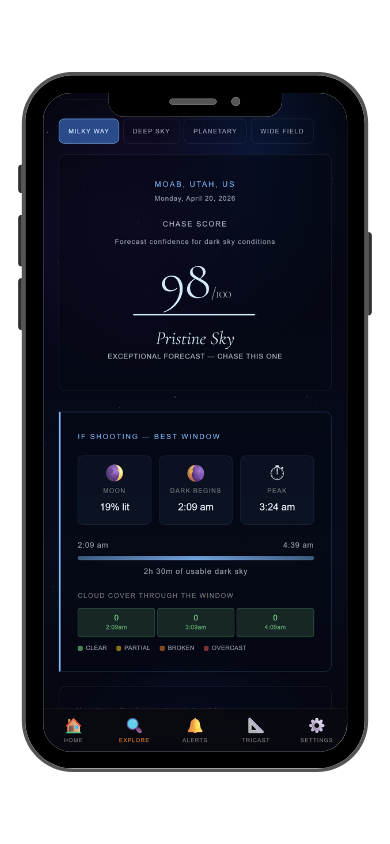
The live score above pulls today's forecast and runs it through StarCast's scoring model, factoring in cloud cover, moon illumination, Bortle class, humidity, and atmospheric transparency. Above 70 is an excellent night. Below 40, conditions are poor. The score updates daily.
What makes Yellowstone good for astrophotography?
Yellowstone sits on a high volcanic plateau averaging 7,000 to 8,000 feet elevation, with large portions of the park rated Bortle Class 1, the darkest classification on the scale. The park is working toward formal International Dark Sky Park designation and has been systematically reducing its own light footprint. The geothermal features — steaming geysers, boiling mud pots, and mineral terraces — create foreground options available at no other dark sky location on Earth. Lamar Valley, Hayden Valley, and Swan Lake Flat are the classic wide-open positions for Milky Way photography, with animal activity adding unpredictable foreground interest. Old Faithful erupts every 65 to 95 minutes through the night and can be timed against the galactic core. The park hosts annual Stars Over Yellowstone astronomy programs at the Madison Amphitheater in summer.
When is the Milky Way visible at Yellowstone?
The galactic core is visible from late spring through early fall, with June through August producing the best positioning. The park's high elevation means noticeably cooler temperatures even in summer, so layers are essential for night sessions. Dunraven Pass at 8,859 feet, the highest road in the park, provides wide elevated sky views for those willing to drive a mountain road in the dark. Winter access in the park is limited to snowcoach and snowmobile, but the Steam, Stars and Winter Soundscapes tour offers a guided night sky experience in the snow season.