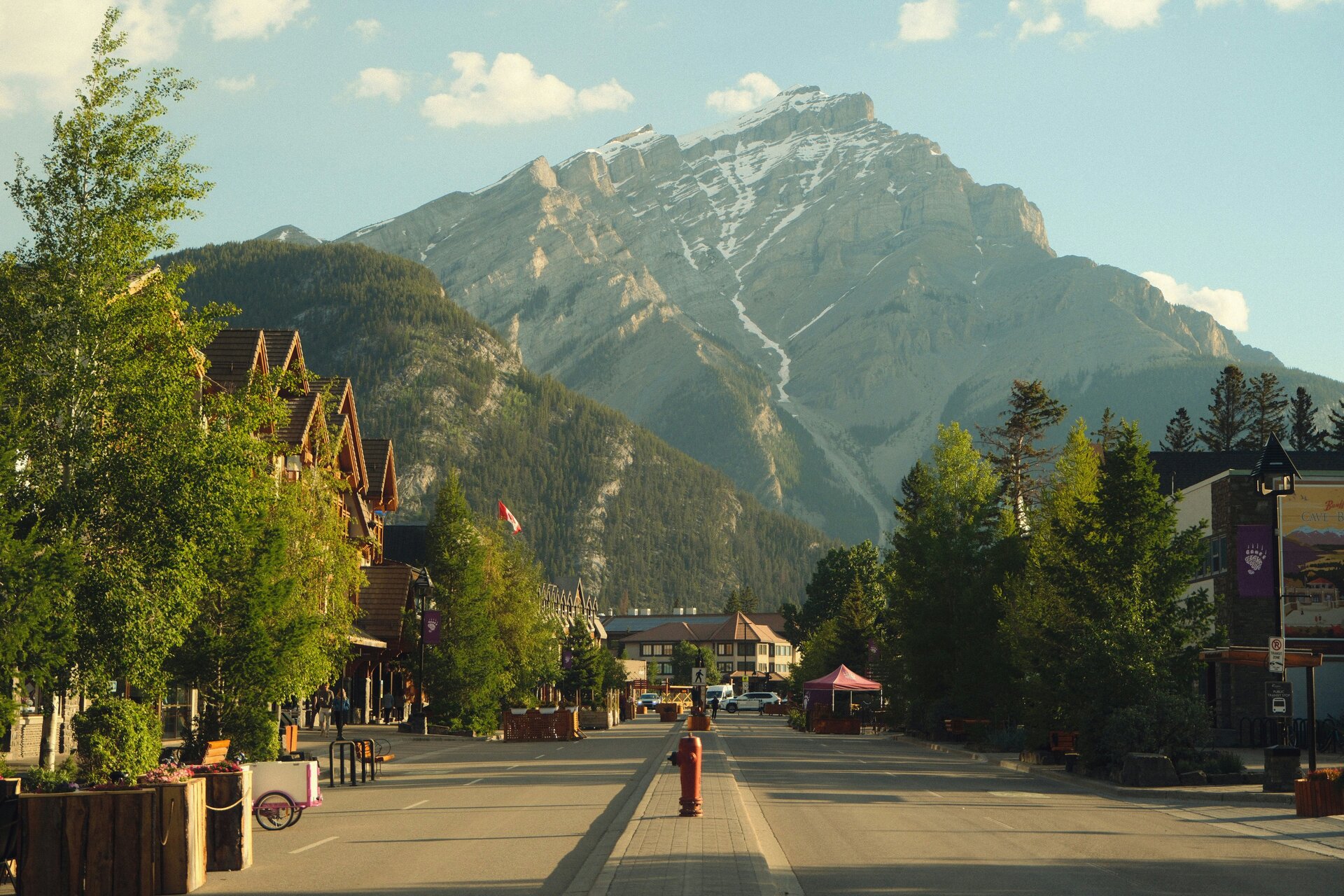
 Banff National Park, Alberta
Banff
Photography Conditions
Sunset · Astrophotography · Landscape · Pre-loaded for Banff
The most accessible and least crowded of Banff's classic reflection lakes. Two Jack faces east toward Mount Rundle — at sunset alpenglow lights the mountain's east face from across the lake while the reflection doubles the composition below. At night the Milky Way arcs south over the lake with the dark Rundle silhouette as foreground. Accessible by car year-round; the lakeside is short, flat, and easy to navigate in the dark. Arrive 45 minutes before sunset to find a clear position on the western shore. In winter the lake freezes and creates extraordinary ice-texture foreground.
Check tonight's conditions →One of the most photographed viewpoints in Canada. The Rockpile above the lake faces east toward the Valley of the Ten Peaks — at sunrise the first light hits the peaks in sequence from left to right while the turquoise lake glows below. The lake's colour comes from glacial rock flour suspended in meltwater — most vivid in July and August. Parks Canada now requires shuttle reservations in peak season; private vehicle access is restricted. Arrive before the first shuttle (typically 5:30–6 AM) or book the first shuttle of the day. Check Parks Canada's current system before visiting.
Check Moraine Lake forecast →The glacial lake with the Victoria Glacier at its head is one of Canada's iconic images. At sunrise the glacier glows pink before the sun clears the eastern ridgeline while the lake surface is perfectly still — the best window is the 20 minutes before direct light arrives. The Fairmont Chateau Louise on the lake's south shore adds architectural foreground. The lakeside path is accessible year-round. In winter the lake freezes and Parks Canada grooms skating paths — the glacier above a frozen lake at blue hour is extraordinary. Crowds build from 8 AM in summer; arrive by 5:30 AM.
Check Lake Louise conditions →The Icefields Parkway (Highway 93) north from Lake Louise toward Jasper is one of the world's great drives — and one of the most productive photography corridors in North America. Peyto Lake viewpoint gives the famous turquoise wolf-head shaped lake surrounded by Waputik Range peaks. Bow Lake (40 km north of Lake Louise) offers a flat, accessible glacial lake for Milky Way shooting. Athabasca Glacier and the Columbia Icefield (105 km north) give glacier-foreground compositions. Check Goldcast and Starcast before committing to the long drive north — mountain weather varies significantly along the corridor.
Check Icefields Parkway tonight →| Location | Distance from Banff | Bortle | Best for | |
|---|---|---|---|---|
| Two Jack Lake | 13 km | 3–4 | Mount Rundle reflection, Milky Way south | Starcast → |
| Bow Lake | 90 km | 3 | Flat glacial lake, wide-field MW foreground | Starcast → |
| Peyto Lake viewpoint | 100 km | 3 | Turquoise lake, Waputik Range panorama | Starcast → |
| Athabasca Glacier | 175 km | 2–3 | Glacier foreground, Columbia Icefield | Starcast → |
- Larch trees at Larch Valley (above Moraine Lake) and Paradise Valley turn vivid gold mid-September to early October — one of Canada's finest photography events
- Summer crowds drop sharply after Labour Day: Moraine Lake and Lake Louise are actually manageable
- Star transparency peaks in September and October: cold dry continental air gives the clearest skies of the year
- Snow can arrive in October adding dramatic contrast to larch gold and turquoise lake colour
- Sunset after 9:30 PM MDT in June — the longest mountain alpenglow of the year
- Wildflowers across the high meadows July through early August: Sunshine Meadows and Skoki Valley are exceptional
- Moraine Lake shuttle reservations mandatory: book months in advance for summer visits
- Milky Way season peaks but summer nights are short — the core window between astronomical dusk and dawn narrows significantly in June
- Lake Louise and Two Jack freeze by December — ice texture and snow-covered peaks give unique compositions unavailable in summer
- Golden hour at 4:00 PM MST: the low winter sun rakes across the Rockies at extreme angles producing exceptional quality light
- Banff townsite Christmas lights and ice sculptures through December and January
- Cold-weather preparation essential: -20°C to -30°C nights are normal; battery life drops dramatically in the cold
- May is the best wildlife photography month: bears emerging, bighorn sheep lambs, elk calves in the Bow Valley
- Waterfalls (Johnston Canyon lower and upper falls) are at maximum flow as snowpack melts in May and June
- Milky Way core returns in April: Two Jack Lake is ice-off by late April giving the first open-water reflection shots
- Mountain weather in April and May is highly variable: snow can fall at any time, clearing events are often spectacular