 Queenstown, New Zealand
Queenstown
Photography Conditions
Sunset · Astrophotography · Drone Flight · Pre-loaded for Queenstown
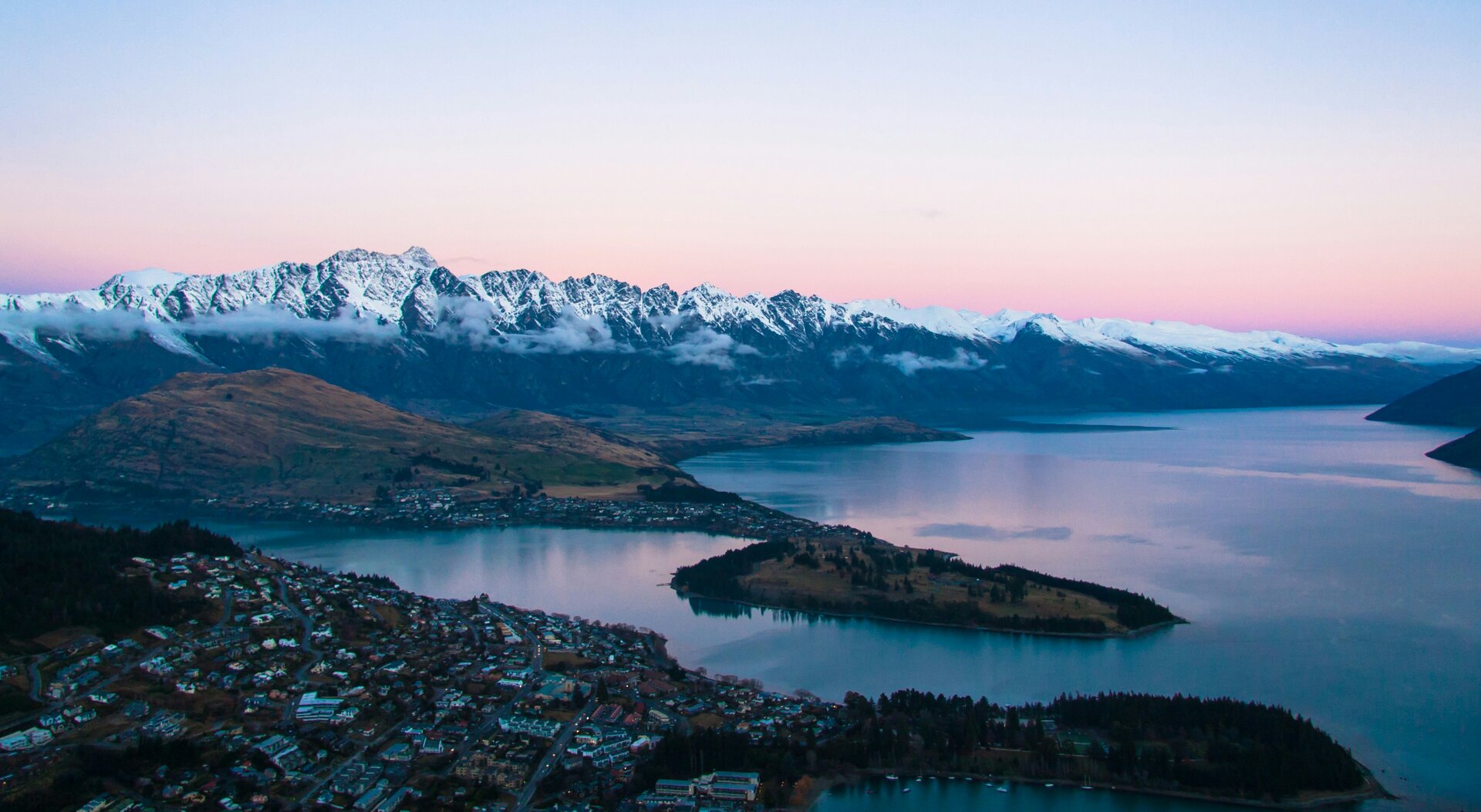
The best elevated view directly above the town. The summit gives a complete panorama: the Remarkables across the lake to the southeast, Cecil Peak and Walter Peak across the water, and the town and bay below. At sunset the Remarkables catch alpenglow long after the sun has set behind the western ridgeline. For astrophotography, the summit is dark enough to see the full Milky Way arc in the north with the lake below. Allow 3+ hours return from town and bring a headlamp for the descent.
Check tonight's sunset →The eastern arm of Lake Wakatipu gives a direct west-facing view across the water toward the Remarkables. At sunrise the peaks catch first alpenglow from behind while the lake reflects the sky below. At sunset the Remarkables are side-lit in pink and orange as the sun drops behind the western ridgeline. The Kelvin Heights peninsula at the end of the Frankton Arm gives an elevated lake-level position. No elevation gain required — accessible by car or cycle along the lake road.
Check Frankton conditions →One of the most photographed trees in New Zealand: a solitary willow growing from rocks in the shallows of Lake Wanaka, with the Southern Alps behind. The tree is best at dawn (face east, first light hits the mountains) and at dusk (wide angle facing west, the lake reflection pulls the mountains down). For astrophotography, face north at night: the Milky Way arcs over the lake from horizon to horizon with the Alps as silhouette. Drive 75 km north from Queenstown on SH6. Arrive early — this tree is popular.
Check Lake Wanaka tonight →The larch forests in the Arrow River valley above Arrowtown are among New Zealand's finest autumn photography locations. Planted European larch trees turn a vivid gold in late April and early May — the bright yellow contrasts against the grey schist rock cliffs behind. Morning light into the valley is the best direction. The historic gold mining town of Arrowtown adds foreground architecture. Dark enough for astrophotography on clear winter nights from the valley edge.
Check Arrowtown forecast →| Location | Distance | Bortle | Best for | |
|---|---|---|---|---|
| Lake Wanaka (valley edge) | 75 km north | 3–4 | Lake reflections, Wanaka Tree foreground | Starcast → |
| Lake Pukaki | 150 km northeast | 2 | Aoraki/Mt Cook reflection, turquoise lake | Starcast → |
| Lake Tekapo (Mackenzie Reserve) | 200 km northeast | 1 | World-renowned dark sky reserve, Church foreground | Starcast → |
| Milford Sound road (Te Anau) | 170 km southwest | 2 | Fiordland dark sky, mirror fiord reflections | Starcast → |
- Late April to early May: the Arrowtown larch forests turn vivid gold — one of NZ's finest photography events
- Crisp clear days with excellent visibility and manageable crowds
- Milky Way still visible in March and April from lake edge locations
- Snow dusting the Remarkables peaks above autumn foliage below — dramatic juxtaposition
- Full snow on the Remarkables from June — the classic winter skyline of Queenstown is extraordinary
- Golden hour arrives around 5:00 PM NZST: the low winter sun rakes across the snow-covered peaks at extreme angles
- Lake Wakatipu doesn't freeze but the morning stillness gives perfect mountain reflections
- Best star transparency of the year on clear high-pressure nights
- October: Milky Way core rises in the north again — Lake Wanaka and Lake Pukaki trips resume
- Snow on the Remarkables persists into October, giving a snow-and-golden-hour combination
- Spring wildflowers in the Central Otago schist landscape by November
- Crowds are lower than summer; excellent all-round conditions
- Sunset at 9:30–9:45 PM NZDT — one of the longest summer golden hours in the Southern Hemisphere at this latitude
- Milky Way core is at peak height in the north: Lake Tekapo, Wanaka, and Pukaki are extraordinary on new moon nights
- Peak tourist season: popular spots crowded but landscape locations away from town are manageable
- Lupine flowers bloom purple and pink across the Mackenzie Country in December and January