 Cape Town, South Africa
Cape Town
Photography Conditions
Sunset · Astrophotography · Drone Flight · Pre-loaded for Cape Town
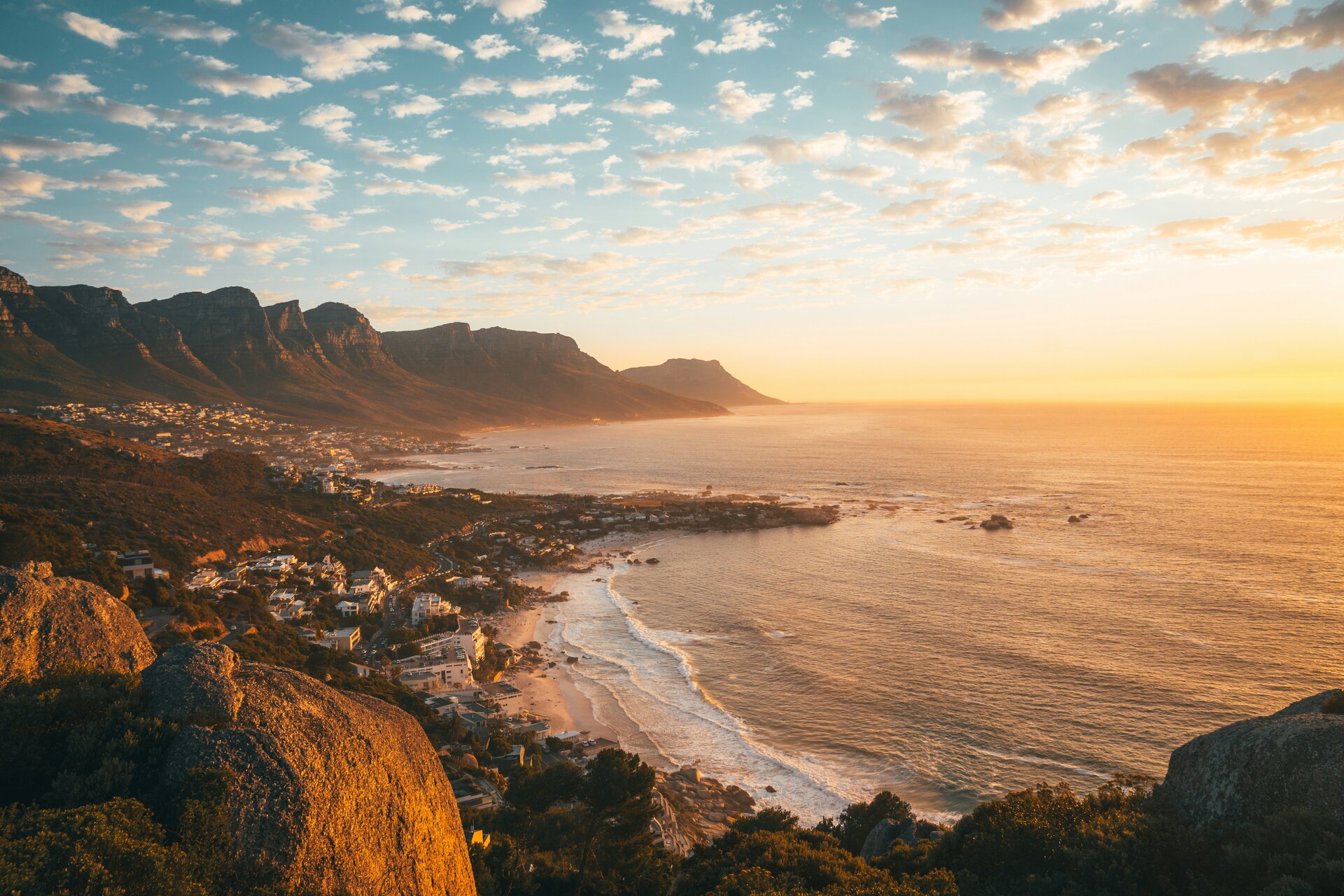
The most accessible sunset viewpoint in Cape Town. The Atlantic seaboard stretches north: Clifton, Camps Bay, and the Twelve Apostles peaks form a dramatic western panorama. Lion's Head rises to the south — include it as a silhouette or shoot west for pure ocean-and-sky. Drive up Signal Hill Road or walk 20 minutes from the lower cable car station. The viewpoint is large and photographers can spread out.
Check tonight's sunset →The definitive Table Mountain-over-ocean shot. Drive 25 km north of the city to the Blouberg beach and face south: Table Mountain, Lion's Head, and the full Cape Peninsula are visible across Table Bay. Best at sunrise when the mountain catches first light from behind you. The beach is unobstructed and gives room to work with foreground waves and long exposures. Check Dronecast: offshore winds here can be severe.
Check Blouberg forecast →The cliff road south of Hout Bay carves through 600-metre-high sandstone with Atlantic viewpoints every few hundred metres. Pull-offs along the drive face directly west over the ocean. Sunset from Chapman's Peak involves waves crashing below and open sky above with no obstructions. The road is toll-operated and closes in extreme winds. This is the Cape's most dramatic drive-up sunset location.
Check Chapman's Peak forecast →One of the best dark sky destinations in the world. The Cederberg mountains offer Bortle 2 skies with extraordinary rock formations as foreground. The Milky Way core rises in the north from October through April in the southern hemisphere — the galactic center is higher above the horizon here than from any site in Europe. The Algeria Campsite and Dwarsrivier Farm are the main base camps. Plan 3 hours from Cape Town.
Check Cederberg tonight →| Location | Distance | Bortle | Best for | |
|---|---|---|---|---|
| Overberg (Villiersdorp area) | 100 km east | 3–4 | Near-city escape, mountain foreground | Starcast → |
| Cederberg Wilderness | 230 km north | 2–3 | World-class dark sky, sandstone rock formations | Starcast → |
| Tankwa Karoo | 280 km north | 2 | Bortle 2 desert, flat horizon, extreme clarity | Starcast → |
| Sutherland (SALT Observatory) | 370 km northeast | 1–2 | Africa's premier dark sky, Southern African Large Telescope site | Starcast → |
- Sunset at 8:00–8:15 PM — the longest golden hours of the year
- South-easter wind peaks: dramatic cloud formations over Table Mountain (the tablecloth)
- Milky Way core high in the northern sky — Cederberg and Tankwa Karoo are spectacular
- Strong winds frequently ground drones: check Dronecast before every flight
- March and April are the sweet spot: summer-length days, calmer winds
- Milky Way core still visible through April — last chance for the season
- Vineyard harvest in Franschhoek and Stellenbosch adds foreground variety
- Consistently high Goldcast scores as humidity drops and visibility improves
- Cape's wet season: frontal systems roll in frequently from the southwest
- Storm clearing events produce some of the most dramatic light of the year
- Snow on Table Mountain (rare) and the Hottentots Holland mountains is possible
- Golden hour at 5:45 PM — short but the low winter sun rakes across the mountain face
- Fynbos and West Coast wildflowers peak in August–September: rare landscape color
- West Coast National Park wildflower fields are active September through October
- Milky Way season resumes in October — Cederberg trips are worth planning
- South-easter begins building: watch wind forecasts through November