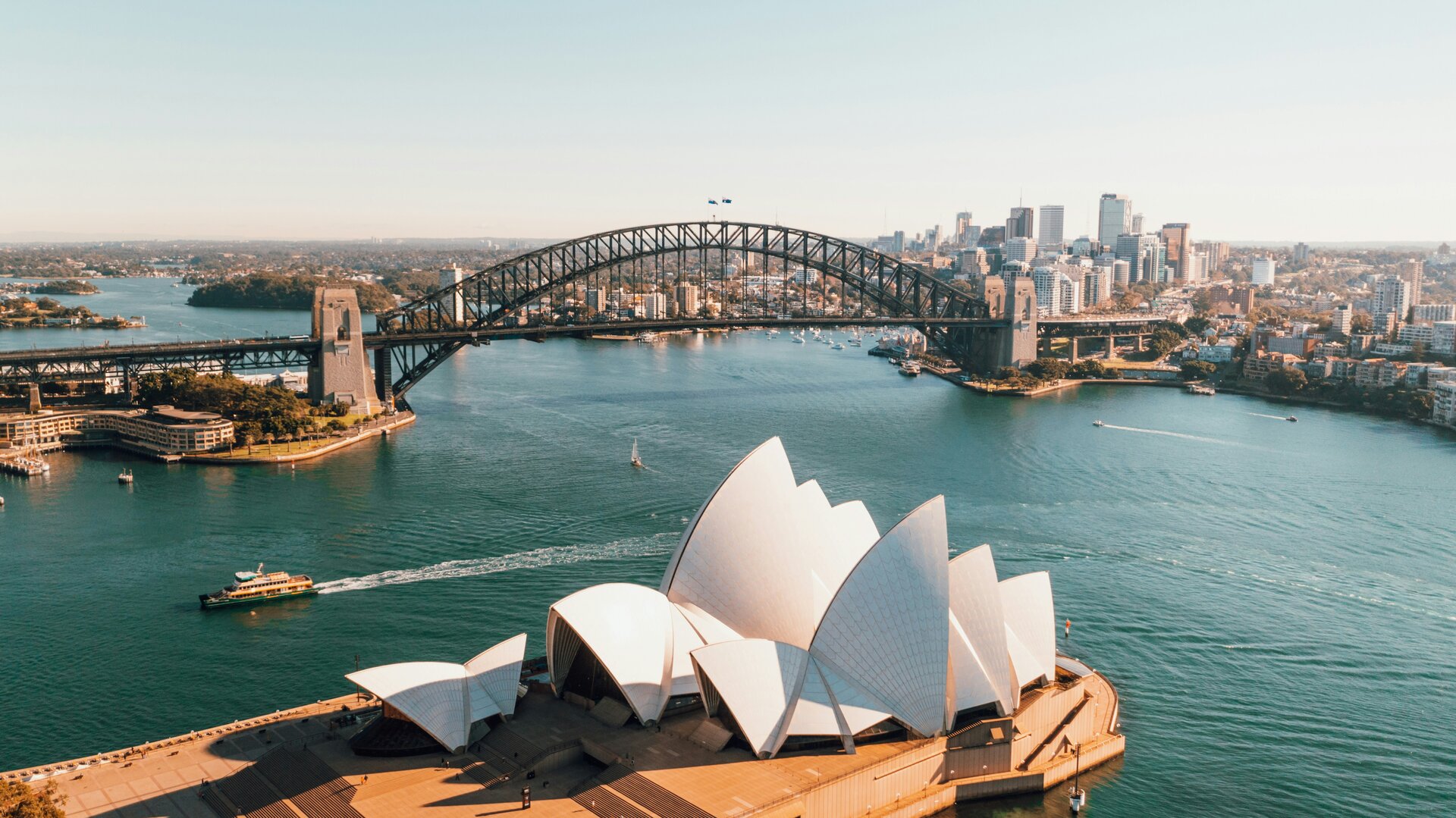
 Sydney, Australia
Sydney
Photography Conditions
Sunset · Astrophotography · Drone Flight · Pre-loaded for Sydney
The north shore foreshore gives the most complete Sydney composition: Opera House to the left, Harbour Bridge arching overhead, and the CBD skyline to the right. At sunrise the first light hits the Opera House shells from the east while the bridge catches warm colour. Blues Point Reserve (400 m east) gives a slightly different angle with more of the harbour visible. Both are accessible by ferry from Circular Quay to McMahons Point or Milsons Point station. Crowd levels are manageable compared to Mrs Macquaries.
Check tonight's sunset →The carved sandstone bench on the Domain foreshore gives the classic Opera House and Harbour Bridge composition across Farm Cove. At sunrise the Opera House shells catch the first eastern light while the sky fades from pink to blue behind the CBD to the west. This is one of Sydney's most photographed positions — arrive 30+ minutes before sunrise to secure the waterfront. The foreshore path continues around to the Andrew (Boy) Charlton Pool area for additional angles.
Check sunrise forecast →Bondi faces east — sunrise over the Pacific with the iconic curved beach and the Icebergs pool at the south end. The coastal walk south to Coogee (6 km) gives cliff-top views of the Pacific with the city skyline visible to the north on clear days. At sunset the western sky behind the beach glows while the ocean reflects the colour. Tamarama, Bronte, and Clovelly beaches along the walk are each worth a stop. Bring good shoes: the cliff path is rocky in sections.
Check Bondi forecast →The closest accessible dark sky from Sydney. The Blue Mountains plateau sits at 1,000 m and gives Bortle 4–5 skies with deep sandstone canyon foregrounds. The Three Sisters at Katoomba and the Govetts Leap lookout at Blackheath are classic positions. Milky Way core rises in the north (southern hemisphere) October through April. The train from Central to Katoomba runs all night on weekends. Cold winter nights (June–August) give the best transparency, but the core is below the horizon in that window.
Check Blue Mountains tonight →| Location | Distance | Bortle | Best for | |
|---|---|---|---|---|
| Blue Mountains (Blackheath) | 100 km west | 4–5 | Sandstone canyon foreground, train access | Starcast → |
| Southern Highlands | 120 km southwest | 4 | Open plateau, easy drive | Starcast → |
| Hunter Valley (Barrington Tops) | 200 km north | 3–4 | Rainforest plateau, vineyard foreground | Starcast → |
| Warrumbungle National Park | 450 km northwest | 2 | Australia's only Dark Sky Park, volcanic spires | Starcast → |
- March through May: the sweet spot — summer humidity drops, light quality sharpens, crowds thin
- April is often Sydney's best month: clear days, warm light, and Milky Way core still visible from the Blue Mountains
- Goldcast scores are most consistent in this window across all harbour viewpoints
- Autumn colour is subtle in Sydney (mostly deciduous garden trees) but light quality compensates fully
- Sydney winters are mild (12–18°C) with frequent cold front passages bringing vivid post-frontal light
- Southern winter golden hour is brief (sunset 5:05 PM) but the low sun raking across the Opera House at 4:30 PM is exceptional
- Humpback whale migration passes close to the coastline June through August — Bondi and the headlands are productive
- Milky Way core is below the horizon — full focus on golden hour and Harbour photography
- October: Milky Way core rises in the north again after the winter absence — Blue Mountains trips resume
- Spring wildflowers across the Sydney Basin bushland through September and October
- Crowds build toward December but are still manageable through October
- Humpback whales heading north (southbound in autumn, northbound in spring) — October coastline shots
- Sunset at 8:00 PM AEDT in December — the longest golden hour windows of the year
- Milky Way core is at its highest in the northern sky, best from the Blue Mountains on new moon nights
- Bushfire smoke (December–February) can dramatically reduce visibility — check Goldcast aerosol score before any harbour or mountain shoot
- New Year's Eve: Sydney Harbour Bridge fireworks are one of the world's most photographed events — positions require booking 12+ months ahead
