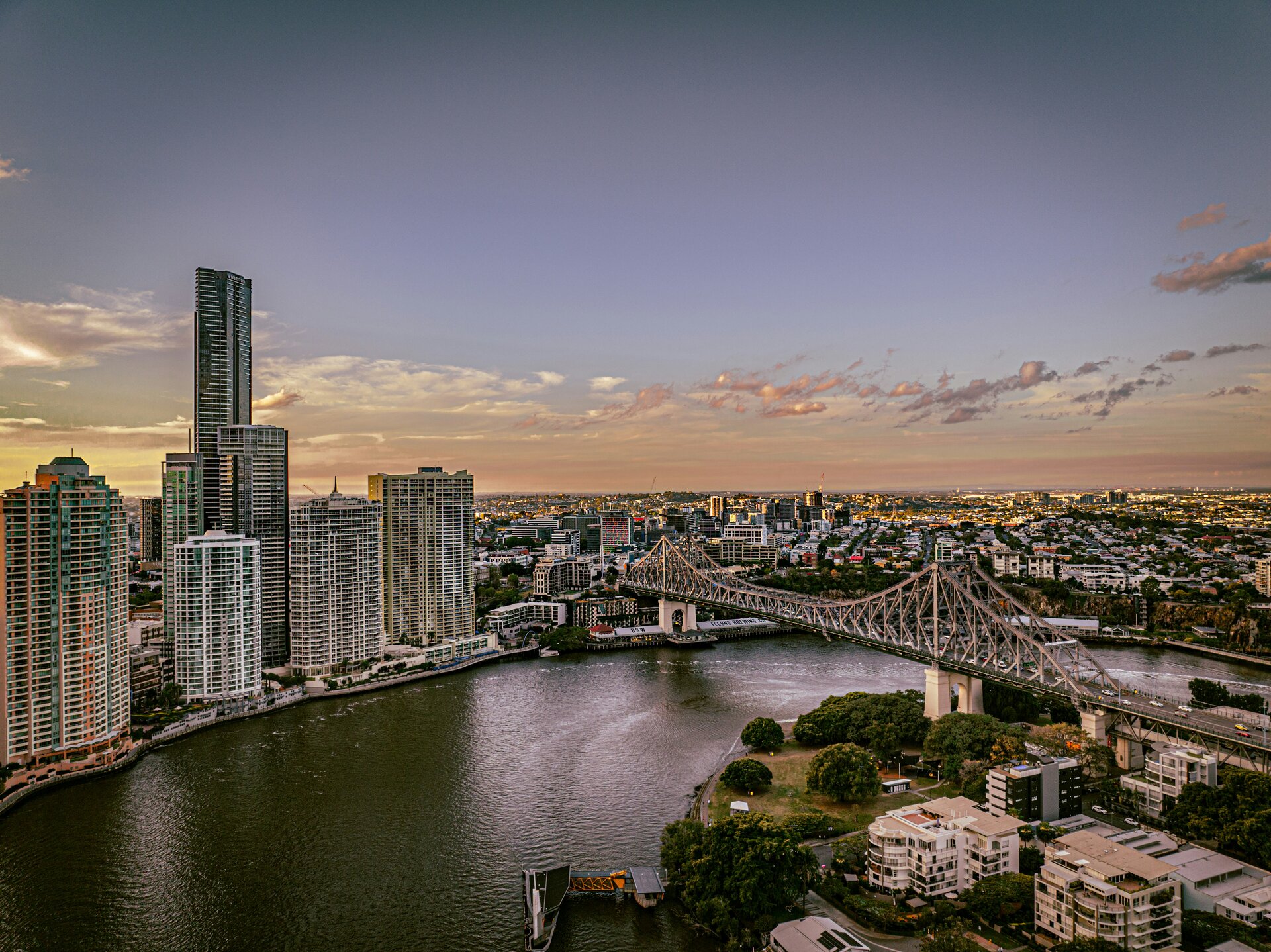
 Brisbane, Queensland
Brisbane
Photography Conditions
Sunset · Astrophotography · Drone Flight · Pre-loaded for Brisbane
The best elevated city photography position in Brisbane. The basalt cliffs on the south bank of the Brisbane River rise 20 m above the water and face directly northwest toward the CBD — at golden hour the towers catch warm side light while the river curves below them in both directions. At sunrise the first light hits the eastern facades of the CBD from across the river. The Story Bridge is visible to the northeast, completing the composition. The clifftop path and lookout are flat and accessible; the rock climbing area at the base gives a different low-angle perspective with the cliffs as foreground. Arrive 20 minutes before golden hour to claim a position on the clifftop railing.
Check tonight's sunset →Brisbane's highest accessible viewpoint and the most comprehensive panorama of the city. From 287 m the CBD, the western suburbs, Moreton Bay, and the Glasshouse Mountains on clear days all come into view simultaneously. At sunset the sun drops behind the D'Aguilar Range to the west and the city below catches the last warm light before the skyline switches to blue hour and the towers illuminate. The summit cafe and restaurants mean the lookout stays open into the evening. On clear winter mornings, the CBD skyline rises from a carpet of valley fog — one of Brisbane's finest photography scenarios.
Check Mount Coot-tha forecast →The Story Bridge photographed from below is one of Brisbane's signature industrial compositions. Howard Smith Wharves, directly beneath the northern pylon, gives the river-level angle looking up at the steel arch against the sky. At sunrise the bridge catches the first eastern light before the CBD towers behind it. The Story Bridge Adventure Climb gives an elevated perspective from the arch itself at golden hour — book in advance. The New Farm Riverwalk (1.5 km east) gives a side-on view of the bridge with the river sweeping in from the east and the CBD behind.
Check Story Bridge conditions →The most visually distinctive dark sky foreground accessible from Brisbane. The Glass House Mountains are remnant volcanic plugs rising abruptly from the Sunshine Coast hinterland — Tibrogargan, Beerwah, and Coonowrin are the most dramatic silhouettes. From the Glasshouse Mountains Lookout or the paddocks around Beerwah, the Milky Way core rises in the north October through April (southern hemisphere) above the jagged volcanic skyline. Bortle 4–5 conditions. Drive 80 km north on the Bruce Highway. Best visited on new moon nights in winter and spring — the cooler, drier air maximises transparency.
Check Glass House Mountains tonight →| Location | Distance | Bortle | Best for | |
|---|---|---|---|---|
| Glass House Mountains | 80 km north | 4–5 | Volcanic plug silhouettes, distinctive MW foreground | Starcast → |
| Boonah / Scenic Rim | 100 km southwest | 4–5 | Lamington NP edge, mountain range foreground | Starcast → |
| Girraween National Park | 220 km southwest | 3 | Granite boulders and slabs, Granite Belt dark sky | Starcast → |
- Brisbane's winter is mild and reliably clear — the lowest humidity of the year and the most consistent Goldcast scores
- The low winter sun from the northwest rakes across the CBD towers at exceptional angles from Kangaroo Point and Mount Coot-tha
- Valley fog in the western suburbs on cold winter mornings: Mount Coot-tha lookout above the fog with the CBD skyline rising through it is one of Brisbane's finest scenes
- Girraween National Park stargazing: winter nights are the clearest on the Granite Belt, even if the Milky Way core has set by June
- Girraween National Park wildflowers peak September to October — granite boulder landscapes with native flora in bloom
- Milky Way core returns in October (southern hemisphere, core rises in north) — Glass House Mountains trips viable on new moon nights
- Storm season begins building in November: afternoon thunderstorm systems produce dramatic cloud formations over the D'Aguilar Range
- Brisbane River at spring high water after inland rain: reflections of the CBD in the swollen river can be exceptional
- Daily afternoon storms are the main obstacle — but they clear and leave washed, vivid air behind them
- Post-storm golden hour: the 30-minute window after a storm clears can produce extraordinary sky color over the CBD skyline
- Milky Way core is highest in the sky January and February — peak conditions for Glass House Mountains and Girraween, despite summer humidity
- Moreton Bay and the offshore islands are at their warmest — accessible by ferry for coastal photography with the city skyline behind
- March and April: storm season ending, humidity dropping, Goldcast scores improving week by week
- Milky Way core still up in March and April (southern hemisphere) — the last viable window before it sets for winter
- May is the start of the best photography season: clear air, warm days, cool evenings, and the CBD at its photogenic peak without summer haze
- Autumn colours are subtle in subtropical Brisbane but the jacaranda trees begin their purple bloom in October and November (overlapping spring)
